
Veins around the eyes
How to Get Rid of Veins around the Eyes
Veins around the eyes are usually a cosmetic concern rather than a sign of serious disease. However, they can become more noticeable with age and may affect confidence because they appear in one of the most visible areas of the face. Genetics, skin thickness and environmental factors can all contribute to their appearance. Importantly, not every visible vessel around the eyes is a varicose vein. Some are fine superficial vessels, while others are larger periorbital veins that create a visible bulge beneath the skin. Understanding the type of vein is essential because modern treatment depends on its size, depth and appearance.
What are veins around the eyes?
The term periorbital veins refers to visible veins around the orbital region, particularly beneath the lower eyelid and towards the outer corner of the eye. The skin in this area is naturally thinner than elsewhere on the face, and there is relatively little fat beneath it. As a result, underlying blood vessels can become more visible even when they are otherwise healthy.
Some veins appear as fine blue, green or red lines that lie flat beneath the skin. Others become enlarged enough to create a raised contour. These larger veins can resemble reticular veins found elsewhere on the body, although they should not automatically be considered a sign of chronic venous disease.
Read more: how do veins work
Why do veins around the eyes become visible?
Several factors influence the appearance of veins around the eyes, with ageing being one of the most important. As collagen and elastin decline over time, the skin becomes thinner and loses some of its natural support. At the same time, the reduction in subcutaneous fat allows underlying veins to become easier to see.
Genetics also plays an important role. People with naturally thinner skin or a family history of prominent facial veins may notice these vessels earlier in life. Although hereditary factors increase the likelihood of visible veins, they do not usually indicate an inherited venous disorder.
In addition, long-term sun exposure can weaken the skin's supporting structures, making superficial vessels more apparent. Smoking may contribute to similar skin changes, while significant weight loss can reduce the tissue covering the veins and make them stand out more clearly.
Are veins around the eyes a medical problem?
In most cases, veins around the eyes do not require medical treatment because they rarely cause pain, swelling or functional problems. For many people, treatment is therefore elective and focuses on improving appearance.
However, a specialist assessment becomes important if a prominent vein appears suddenly, changes rapidly, becomes painful, or develops alongside symptoms such as eye protrusion, double vision or visual disturbance. These features may indicate an uncommon orbital vascular condition rather than a simple cosmetic concern and require prompt medical evaluation.
How were prominent veins around the eyes treated in the past?
In the past, treatment options for veins around the eyes were more limited. Smaller superficial vessels were often treated with vascular lasers, while larger bulging veins were much more difficult to manage because surface laser treatment could not always reach deeper or wider vessels effectively.
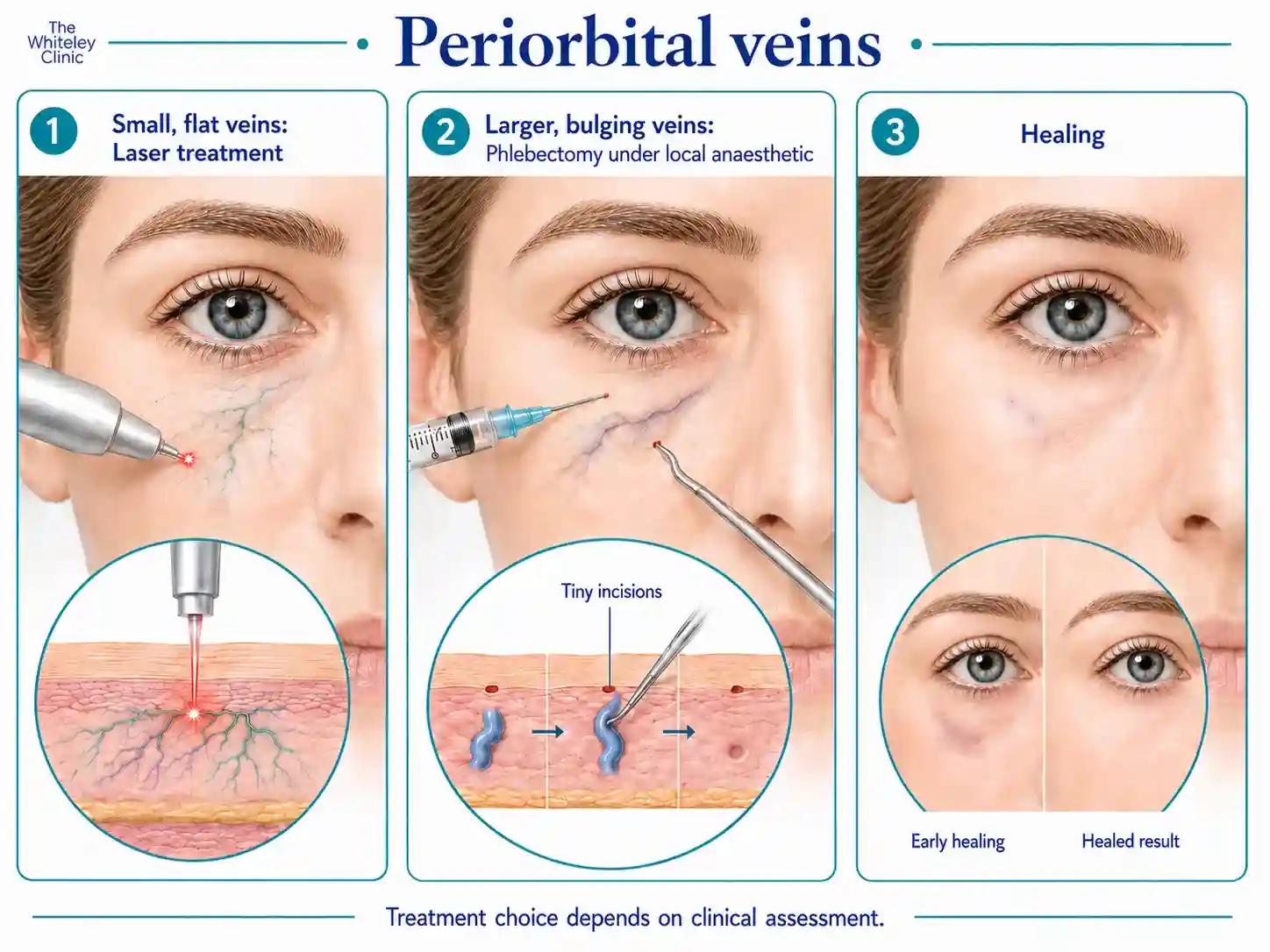
As treatment techniques evolved, a more targeted approach became available for larger periorbital veins. Instead of relying on surface treatment alone, specialists began removing selected prominent veins through tiny skin openings under local anaesthetic. This minimally invasive technique, known as phlebectomy, allows the affected vein to be removed directly while leaving very small wounds that usually do not require stitches.
What are the modern treatments for veins around the eyes?
Modern treatment matches the procedure to the type, size and position of the vein. This approach avoids using the same treatment for every patient.
Fine blue or green veins that remain flat beneath the skin may be suitable for transcutaneous vascular laser treatment. The choice of treatment depends on factors such as the vein’s colour, depth and size, as well as its position around the eye. Where appropriate, laser treatment can target superficial vessels without the need for surgical removal.
Larger veins around the eyes that create a visible bulge beneath the skin usually require a different approach. According to The Whiteley Clinic’s treatment pathway, specialists may treat prominent periorbital veins with phlebectomy under local anaesthetic. During the procedure, the specialist numbs the area, makes one or more tiny incisions, and gently removes the vein with a specialised hook.
The small wounds normally heal with a simple dressing rather than stitches. If any fine superficial vessels remain, specialists may subsequently treat them with vascular laser.
What should happen before treatment?
Before choosing a treatment, a specialist should assess the visible vessel. This helps determine whether it is a superficial vein, a larger reticular vein or a less common vascular abnormality.
The vein's size, depth, colour and anatomical position all influence the safest and most effective treatment option.
Because the orbital region contains delicate structures, treatment requires careful planning and an accurate diagnosis. Patients concerned about veins around the eyes can submit photographs for assessment, helping determine whether a surgical consultation at The Whiteley Clinic or laser treatment at Absolute Aesthetics Clinicis likely to be the most appropriate next step.