Klippel-Trenaunay Syndrome (KTS)
March 26, 2026
Varicose vein treatment has improved significantly in the last ten years. In the past, people often needed vein stripping under general anaesthesia and long hospital stays. Now, that’s rarely necessary. Thanks to medical advances, modern techniques have become safer, quicker, and more comfortable.
One such technique is the Venaseal procedure, now offered at The Whiteley Clinic, where patients can benefit from one of the most popular vein treatments available today.
Often referred to as the “superglue” treatment, Venaseal not only offers a simpler method for closing faulty veins but also reduces pain during the procedure. However, the advantages need to be considered against the risk of an allergic type reaction and an increased cost over other minimally invasive techniques.
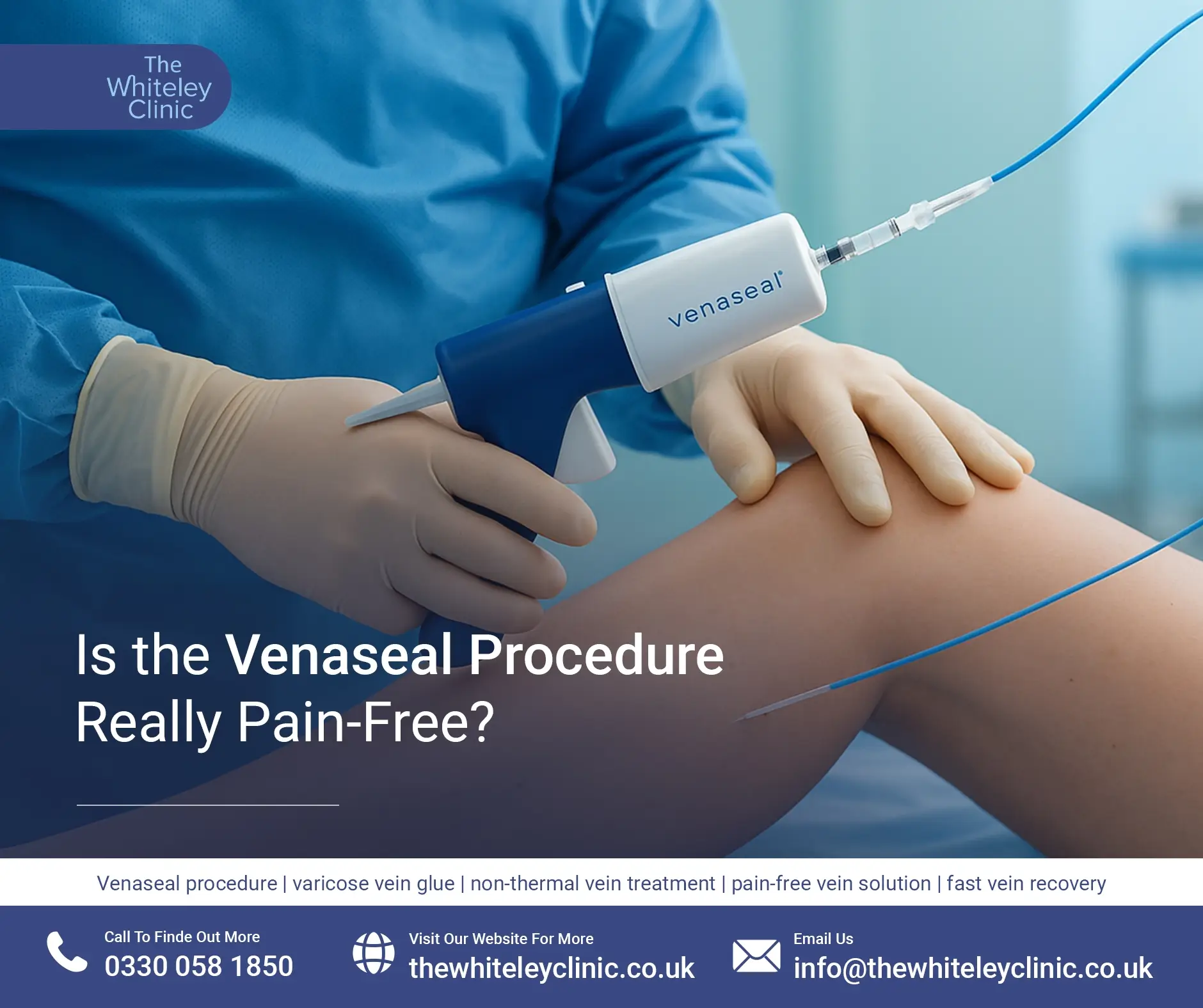
The Venaseal procedure uses a special medical glue to seal unhealthy veins inside the leg. Unlike thermal treatments such as endovenous laser ablation (EVLA)
radiofrequency ablation (RFA), Venaseal avoids the use of heat and large volumes of local anaesthetic called “tumescence”. As a result, patients experience less pain. In addition, the procedure requires fewer injections and provides a much gentler, faster, and more comfortable experience overall.
The doctor begins the treatment with a small injection to numb the skin. Using ultrasound guidance, they insert a thin catheter into the faulty vein. This catheter, about the size of a pen refill, allows precise delivery of the medical glue. The doctor slowly releases small drops of adhesive, each sealing approximately 5 cm of the vein. After applying each drop, they pause briefly to allow the glue to harden. Then, they carefully pull the catheter back and repeat the process. Step by step, they continue until the entire targeted vein is sealed.
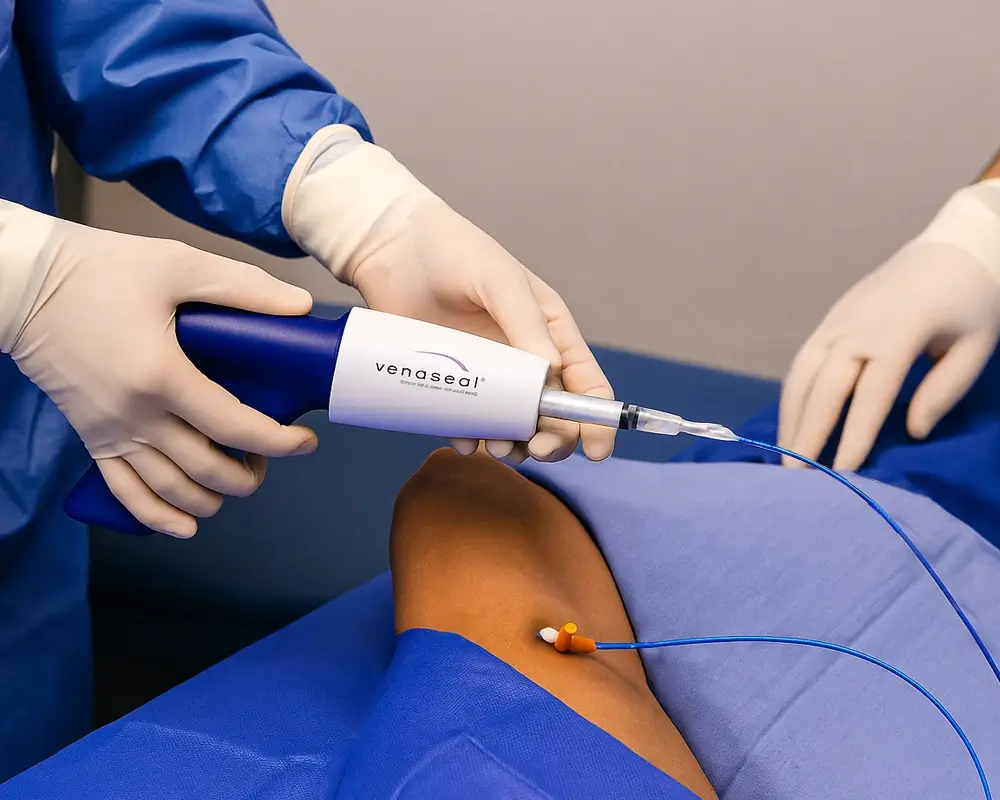
Comfort is a major reason why people choose the Venaseal procedure. It requires only one injection, which is particularly reassuring for those with needle anxiety. The glue works without generating heat or causing trauma; therefore, patients experience minimal bruising and swelling. As a result, most do not need to wear compression stockings afterwards. There are also no stitches involved, meaning most patients can walk out of the clinic shortly after the procedure. Because the treatment is gentle, recovery is usually quick. In fact, many return to work or their daily activities on the same day.
However, about 1-in-5 to 1-in-10 patients can get an irritation of the vein and overlying skin called PLAR (Phlebitis-like Abnormal Reaction). This can last 1 - 2 weeks after the procedure and is uncomfortable and can cause a red, tender streak on the skin. It usually settles by itself, but it rarely needs steroids to calm it down. Very rarely, the glue and the vein have to be removed surgically, although this has only been reported a few times in the world.
Patients also need to be aware that the cost of the glue is currently more than the cost of the alternatives, such as EVLA (Endovenous Laser Ablation), and so there is a cost to the quicker and less painful procedure.
A short video filmed at The Whiteley Clinic demonstrates each step of the Venaseal procedure in real time. The clinicians guide the needle and catheter into place using ultrasound. They carefully deliver the glue and slowly pull the catheter back as the vein seals shut. At the end, they remove the catheter, leaving only a tiny puncture. There are no cuts or stitches—just a clean, precise result with minimal scarring.
You can Watch the full video below:
Professor Mark Whiteley and his team were among the first in the UK to offer the Venaseal procedure. In 2013–2014, The Whiteley Clinic participated in a European multi-centre research study with excellent results. The findings, published in a respected medical journal, showed closure rates comparable to EVLA and RFA, while patients reported less discomfort and better cosmetic outcomes.
In one case, the team treated both legs using just two injections. They only needed a few small extra shots to remove surface veins. No stitches were required. The tiny wounds healed quickly with just adhesive dressings, and the patient did not need a hospital stay.
More than ten years later, follow-up studies confirm that Venaseal remains effective long-term. Treated veins stay closed, recurrence is rare, and patient satisfaction is very high.
Today, patients want treatments that are effective yet fit easily into busy lives. The Venaseal procedure meets these needs perfectly. It is quick, clean, and delivers lasting results. At The Whiteley Clinic, experienced doctors follow strict safety protocols to ensure the best outcomes.
With over a decade of clinical use, Venaseal has evolved from an innovative option to a trusted first-line treatment. It suits anyone with relatively simple veins on scanning, seeking fast recovery, fewer injections, and excellent cosmetic results.