



How Can You Effectively Treat Calluses and Corns on Feet?
August 15, 2026
An accurate diagnosis of the type of leg ulcer is essential for effective treatment and recovery. Unfortunately, many people endure months or even years of recurring wounds because their leg ulcer diagnosis was incomplete or inaccurate. In this article, we explain what a leg ulcer is, the early signs to watch for, why an incorrect diagnosis can lead to chronic problems, and how following The Whiteley Protocol® ensures a reliable path to recovery. We also highlight the vital role of vascular technologists, the importance of detecting hidden problematic veins, and what patients can expect from effective treatment and healing.
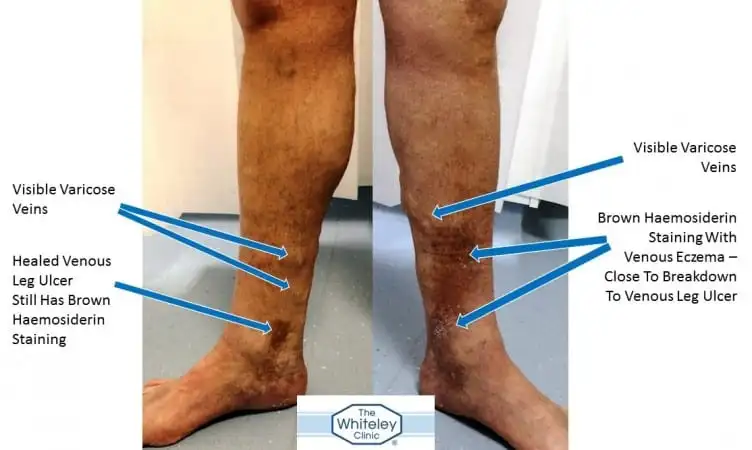
A leg ulcer is a stubborn wound on the lower leg that does not heal within the expected time. Most leg ulcers result from venous reflux, where faulty valves inside the leg veins allow blood to flow backwards. This malfunction increases pressure in the veins, causing damage to the skin and underlying tissue over time. This leads to swelling and discolouration, which can eventually develop into an open sore.
Typical warning signs that prompt a leg ulcer diagnosis include darkened skin from haemosiderin deposits, itching or dryness known as venous eczema, swelling around the ankle, and visible varicose veins. These signs often indicate impaired circulation which, if untreated, will develop into a leg ulcer.
Accurate and thorough diagnosis of a leg ulcer is vital to ensure effective treatment. Sadly, some patients are told their condition cannot improve and that they must rely on compression stockings for life. This advice usually follows an incomplete or superficial assessment.
Duplex ultrasound remains the most reliable method to evaluate venous reflux in suspected leg ulcers. However, the accuracy of this scan depends heavily on the expertise of the operator. Vascular technologists trained by Professor Whiteley, using The Whiteley Protocol®, follow a step-by-step process to identify every source of reflux, including less obvious veins. Without this precision, critical problem areas may be overlooked.
For example, a patient came to The Whiteley Clinic after years of dealing with recurring leg ulcers and noticeable skin changes. Despite previous vein stripping surgeries and standard scans elsewhere, he was told only to wear compression stockings for life. However, a detailed assessment using The Whiteley Protocol® revealed that deeper veins, including incompetent perforators, were causing his symptoms. With targeted treatments like EVLT and the TRLOP technique, his healing progressed quickly, the skin discolouration faded, and the risk of future ulcers greatly diminished. Stories like this highlight the importance of precise diagnosis and specialist care. If you are experiencing similar symptoms, book a free consultation at The Whiteley Clinic to start your treatment journey confidently.
When doctors fail to identify certain veins during examination, treatment often fails to address the full cause. As a result, many patients who undergo vein stripping or other procedures still experience recurrence. This happens because deeper or smaller abnormal veins remain unidentified or untreated.
Incompetent perforator veins, small vessels linking the deep and superficial venous systems, are frequently responsible for stubborn ulcers. If these veins are overlooked, healing may only be temporary. Studies confirm that addressing these perforators is crucial for lasting success.
At The Whiteley Clinic, every patient receives a comprehensive leg ulcer diagnosis. This involves Duplex ultrasound performed by highly trained vascular technologists. By strictly following The Whiteley Protocol®, doctors carefully identify all refluxing veins, including large superficial veins such as the great and small saphenous veins, as well as small perforators. As a result, this careful approach significantly lowers the chance of ulcers returning.
If incompetent perforators appear during diagnosis, doctors close them using the TRLOP technique pioneered by Professor Mark Whiteley. Meanwhile, main superficial veins receive treatment with local anaesthetic endovenous laser therapy (EVLT). Doctors manage any remaining abnormal veins with foam sclerotherapy.
When the diagnosis is precise and treatment follows The Whiteley Protocol®, recovery often happens faster than expected. Both EVLT and TRLOP use minimally invasive methods performed under local anaesthetic. Consequently, patients can return to daily routines immediately. Moreover, they can carry out activities while following their doctor’s care instructions.
Foam sclerotherapy, performed a few weeks later, eliminates any remaining problematic veins. As blood flow improves, swelling decreases, venous eczema resolves, and skin discolouration diminishes. Most importantly, the likelihood of developing another ulcer becomes very low.
Without a precise leg ulcer diagnosis and targeted treatment, venous ulcers may heal temporarily; however, they tend to reappear within months. Moreover, each recurrence worsens skin damage and slows recovery. Consequently, chronic pain, infection, and reduced mobility become real risks due to delayed or incomplete diagnosis.
On the other hand, a thorough leg ulcer diagnosis followed by appropriate treatment can break this cycle. In fact, many patients who once thought they needed compression stockings for life often live comfortably without them after proper vein treatment.
Clinicians seeking a comprehensive understanding of venous reflux and its role in ulcer development can consult Understanding Venous Reflux – The Cause of Varicose Veins and Venous Leg Ulcers by Professor Mark Whiteley. This resource covers scientific background, diagnostic methods, and evidence-based management strategies essential for effective care.
Extensive research by Professor Whiteley and his team has demonstrated that treating all refluxing veins, including perforator veins, is crucial for lasting healing and preventing recurrence. See studies here:
Leg ulcers need not be lifelong. With an accurate diagnosis by expert vascular technologists using The Whiteley Protocol®, underlying causes can be treated and recurrence prevented. Detecting every refluxing vein, including incompetent perforators, is key to a complete cure.
Early action leads to better results. If you notice skin changes, swelling, or an ulcer that won’t heal, seeking a specialist opinion could transform your health and your future.