



Klippel-Trenaunay Syndrome (KTS)
March 26, 2026
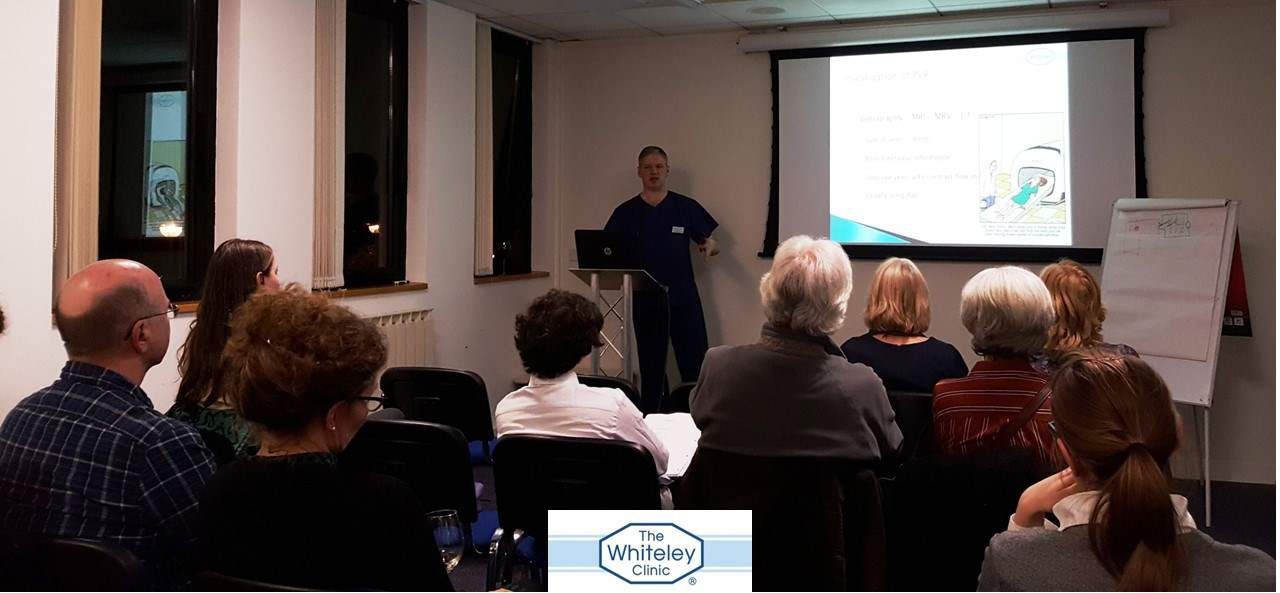
Pelvic pain is often caused by pelvic congestion syndrome. Prof Mark Whiteley gave a talk about the latest research and treatment into chronic pelvic pain (CPP) due to pelvic congestion syndrome. Comments from Meetup about the lecture and question and answer session: (Meetup link)
Research has shown that 13-40% of women going to Gynaecology outpatients with chronic pelvic pain have pelvic congestion syndrome. Unfortunately, gynaecologists do not regularly look for pelvic congestion syndrome as it is a venous problem. It is not diagnosed by laparoscopy, and MRI and CT scanning often miss it.
Pelvic pain and pelvic congestion syndrome - lecture by Prof Mark Whiteley Surrey Research Seminar series - 22 Feb 2017
The reason for this is that the veins are deep in the pelvis, hidden behind a layer called peritoneum and cannot be seen by laparoscopy. MRI and CT are performed lying flat, and varicose veins do not fill up when you lie flat! This was proven in some The Whiteley Clinic research recently published in the European Journal of vascular and endovascular surgery. (see: https://www.ncbi.nlm.nih.gov/pubmed/25457295) The gold standard for identifying pelvic congestion syndrome appears to be transvaginal duplex ultrasound scan using the Holdstock technique. This was invented by Judy Holdstock of The Whiteley Clinic. (see: https://thewhiteleyclinic.co.uk/diagnosis/transvaginal-duplex-ultrasound-scanning-tvs/)
Not everybody with chronic pelvic pain (CPP) has pelvic congestion syndrome. However, up to 40% of women suffering from pelvic pain do have this problem. What makes this worse is that doctors rarely consider this is a diagnosis and rarely investigate or treat it. The Whiteley Clinic has been involved in research and treatment into pelvic congestion syndrome since 2000. We are currently involved in the submission of a white paper to the government on the subject. This will be presented to MPs at the College of Phlebology 1st International Veins meeting on the first 16th of March 2017. (see COP 1st International Veins Meeting)
If you worry that you may have pelvic congestion syndrome, you can undergo a free assessment online using the following link: https://thewhiteleyclinic.co.uk/self-assessment/pelvic-congestion-screening/

"Great speaker and very informative."
"Fascinating and extremely informative"
"Excellent talk by Mark Whiteley"