



Unveil the Hidden Causes of Varicose Veins for Permanent Treatment Results
February 19, 2026
Corns and calluses are among the most common issues affecting the feet. These patches of thickened skin may seem harmless at first, but they can quickly cause discomfort and even pain. If left untreated, they might interfere with normal walking and gradually reduce overall quality of life. In this article, we will outline what calluses are, why they develop, the different types that exist, and how podiatrists and chiropodists can provide safe and effective treatment.
A callus is an area of skin that becomes hard and thick due to repeated friction or pressure. The skin reacts to this ongoing stress by forming a protective layer. Without this layer, the soft tissue beneath would be at risk of damage. Calluses often have a yellowish appearance and can develop in several locations on the foot.
The most common areas include:
Corns are very similar to calluses, but they develop a hard central core. This hardened centre concentrates the pressure, making the condition more painful than regular calluses. In some cases, the core has the same colour as the surrounding skin and can only be identified by touch. In others, it may appear white or show some discolouration.
There are several types of corns, each with unique characteristics.
These are the classic form most people recognise. They develop where pressure and friction are concentrated on the skin, creating a hardened and painful central core.
These usually appear between the toes, particularly in the gap between the fourth and fifth toes. The same mechanical stress that causes the hard variety begins the process, but sweat collects in the area, softening the thickened skin. As a result, the lesion turns white and feels softer to touch. They are sometimes mistaken for athlete’s foot, a fungal infection.
These resemble tiny seeds on the surface of the foot, often found around the edges of weight-bearing areas. They may occur singly or in clusters and are more common in people with dry skin, a condition known as anhidrosis.
Subungual lesions develop beneath the toenail, making them difficult to treat. There are also fibrous and vascular varieties. A podiatrist or chiropodist is best placed to diagnose and manage these rarer corns.
Corns and calluses may cause mild discomfort, but in many cases, they lead to significant pain. The hardened tissue presses into the softer layers beneath. The ongoing pressure continues to irritate the area, transmitting pain deep into the foot. Seeking treatment is therefore not only about comfort; it also helps prevent further problems with walking, posture, and overall mobility.
Before removing a corn or callus, a podiatrist will first investigate the underlying cause. For instance, ill-fitting shoes, abnormal foot function, or toe-to-toe friction are common contributors. If the underlying issue is not corrected, the corn or callus is likely to return.
Moreover, the thickened skin forms as a protective barrier. Therefore, removing it without addressing the pressure would leave healthy tissue exposed to further damage. This is why an expert assessment is essential.
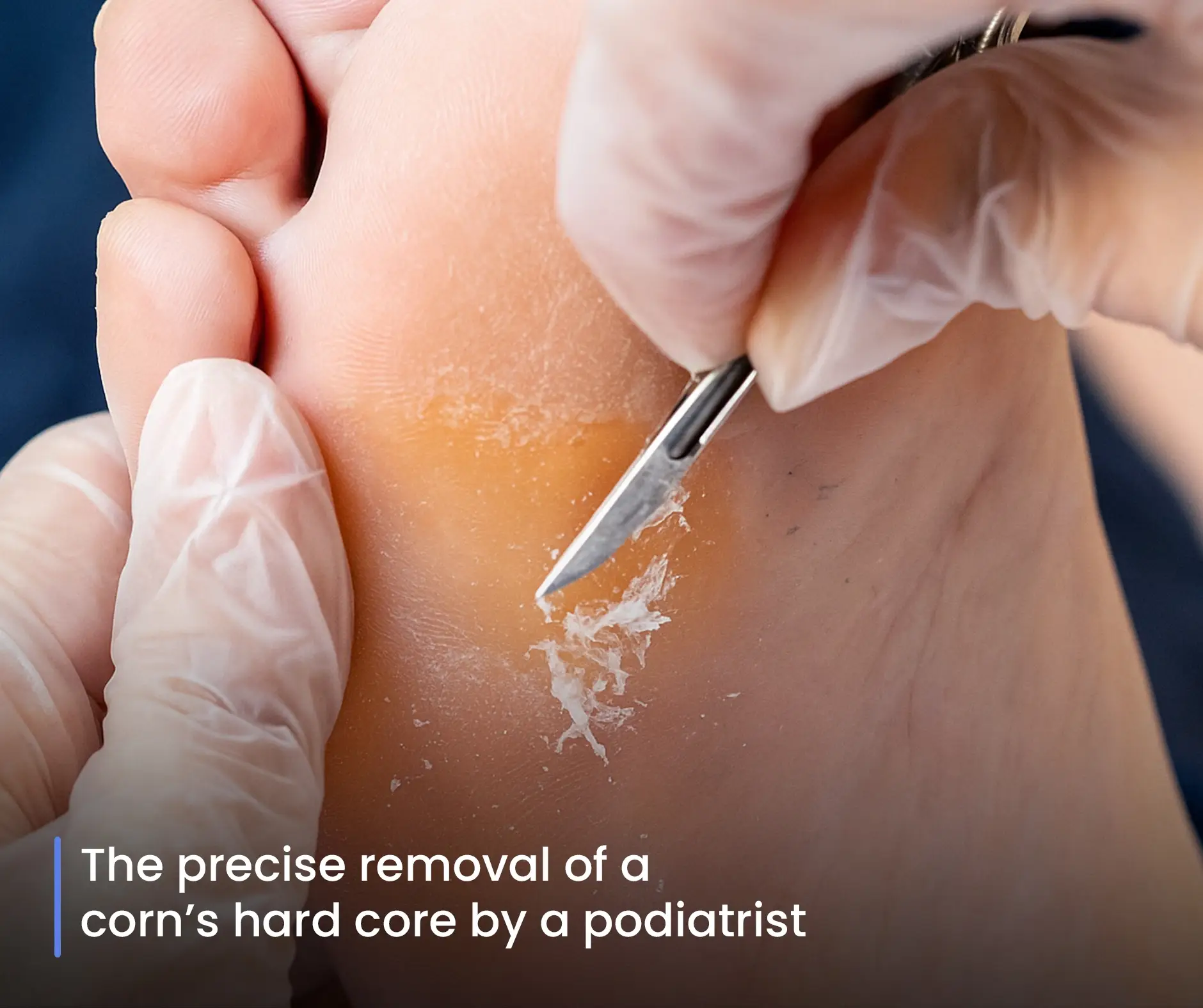
Calluses consist of multiple layers of dead skin. A podiatrist removes these carefully with a scalpel, shaving off thin slices until the hardened tissue is gone. Although this sounds painful, it is not. Because the tissue is dead, there are no nerves. It is like cutting nails or hair.
There is no bleeding and no risk of infection when only dead tissue is removed. In most cases, one treatment session is enough. Patients usually return after six to eight weeks to ensure healthy healing and check for recurrence.
Treatment is similar to calluses, with one key difference: the central hard core must be removed in a process called enucleation. This leaves a small cavity that gradually fills with healthy tissue. Meanwhile, podiatrists and chiropodists often place a protective gel to reduce the chance of recurrence.
For the softer lesions, the specialist carefully removes the dead tissue. A podiatrist may recommend a toe separator to keep the toes apart, reduce friction, and allow moisture to evaporate. Additionally, patients should maintain clean and dry toes, and they can apply alcohol-based surgical spirit to help dry and sterilise the area.
Treatment involves removing these tiny formations and then applying an emollient cream, usually containing urea, to keep the skin hydrated. After the initial treatment, podiatrists typically schedule a follow-up appointment three months later to assess healing and decide if further care is needed.
When the thickened tissue forms beneath the nails, the nail may need trimming or partial removal. Once the lesion is exposed, the podiatrist removes it with a scalpel. In many cases, they apply a caustic agent, such as silver nitrate, to destroy the tissue and prevent recurrence. Additionally, podiatrists monitor patients every two to three weeks to ensure normal nail growth.
These rare lesions contain both nerves and blood vessels. This makes them more sensitive and prone to bleeding during treatment. Podiatrists usually remove them under local anaesthetic. In most cases, complete excision is necessary, and silver nitrate may be used to destroy the tissue. Since recurrence is common, patients may require further treatment.
Prevention is as important as treatment. Well-fitting shoes, regular foot care, and moisturising can reduce the risk. Orthotics may also help to correct abnormal foot function. Paying attention to the health of your feet can prevent pain and avoid the need for repeated treatments.