Unveil the Hidden Causes of Varicose Veins for Permanent Treatment Results
February 19, 2026
Venous valve failure is the focus of a groundbreaking discovery highlighted by Professor Mark Whiteley in a Huffington Post article. In 2001, Mark published the observation that varicose veins are an ascending problem, not a descending one. In other words, it is not pressure from above that causes the top valves to fail first. Instead, it is the failure of valves lower in the leg that gives way initially. Later research by Oliver Lyons, under the supervision of Professor Alberto Smith at King’s College London, provided a mechanism behind this observation. They found that when a lower valve fails, it alters the blood flow. This change in flow contributes to the progressive failure of the valves higher up. Therefore, this insight significantly reshapes the understanding and treatment of venous disease.
Varicose veins and hidden varicose veins are common conditions that affect around 40% of people at some point in their lives. Although varicose veins do not receive the same level of attention as major scientific breakthroughs like Einstein’s theories, they affect a significant portion of the population and progressively decrease quality of life. This condition occurs when the one-way valves inside veins fail, causing blood to flow back down the legs with gravity instead of upwards towards the heart and lungs. If left untreated, the reverse blood flow can lead to complications, such as swelling, skin damage, clots, bleeding, or even leg ulcers.
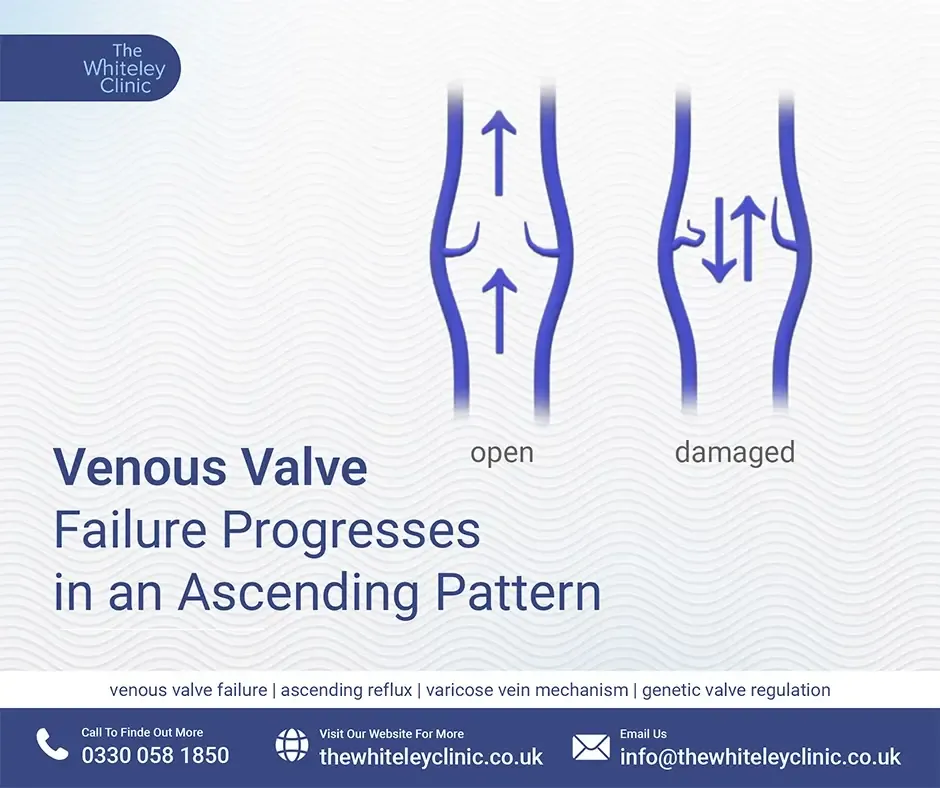
One key question scientists have studied for years is why venous valve failure occurs in some people but not in others. It is known that valves inside veins are paired “leaflets” that allow blood to flow upward toward the heart. When the foot moves, muscle contractions push blood upward, and the valves close to stop it from falling back. When the leg rests, gravity pulls blood downward, but the valve leaflets catch it and prevent the backwards flow. This creates a one-way system for venous blood and helps maintain proper circulation, even during rest periods. In people with varicose veins, these valves fail to close correctly, allowing blood to flow backwards instead of upward. This backwards flow stretches the vein walls. In about half of affected people, visible varicose veins form beneath the skin. These veins often bulge and become noticeable. In the other half, the same process occurs. However, the bulging veins lie deep inside the leg and cannot be seen. These are known as hidden varicose veins. However, despite being hidden, these still cause the same symptoms and problems as visible varicose veins if left untreated. In some cases, the leaking valves lead to tissue inflammation, causing ankle swelling, venous eczema, brown stains, clots, bleeding or leg ulcers. 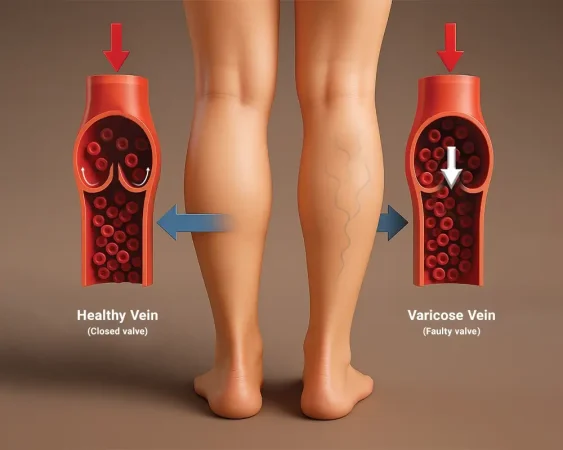
For decades, surgeons and scientists have debated the causes of venous valve failure and its underlying factors. Simple genetics cannot fully explain why varicose veins occur in some individuals and not others. If varicose veins were solely determined by genetic coding, they would appear symmetrically in both legs and in all of the leg veins. However, the condition often affects only one leg or only in specific veins, suggesting other factors contribute to their development. This has led researchers to consider both familial and local influences that suggest a hereditary component beyond direct genetic inheritance.
As with many scientific issues, understanding venous valve failure begins with examining the valves themselves. In children, these valves function efficiently, but with age, some begin to deteriorate. The prevailing theory has long suggested that valve failure results from pressure exerted from above. However, recent studies have revealed a different pattern. The earliest failures usually occur in the lower leg, followed by valves higher up, an “ascending” pattern of valve failure. Read more: How Do Veins Work & What Do They Do
The first group of experts believes the failure occurs in the valve leaflets. They propose that the valve leaflets fail for some reason, allowing blood to flow the wrong way down the vein. This backwards flow, or "venous reflux," causes inflammation in the lower leg. The blood hits the capillaries as it falls, leading to further damage. Additionally, blood pools and collects, resulting in "venous stasis." Experts in this group focus on repairing the valves to resolve the issue.
The second group suggests that vein wall dilation causes the valve leaflets to fail. The dilation prevents the leaflets from meeting properly, and hence stops the valve from working. This allows blood to flow backwards down the vein, once again leading to venous reflux and stasis and hence inflammation in the lower leg. Experts in this group focus on reinforcing the vein wall. They use external cuffs or try to tighten the vein wall to restore valve function. Despite these two theories, experts have overlooked a critical factor: the potential for an alternative mechanism affecting venous valve failure.
Enter the research from Oliver Lyons, working under Professor Alberto Smith at King’s College London. His groundbreaking research has unveiled a completely new understanding of venous diseases, including the causes of valve failure. His team’s findings suggest that a series of genes play a crucial role in ensuring not only the proper development of venous valves but also the continuing health of the valve leaflets. Obviously, when these genes are absent or impaired, abnormal valve development may contribute to disease progression. However, what is more interesting is that the problem is not limited to valve development. Even in fully developed valves, the “switching off” of one or more of these genes can cause complications. This may lead to regression of the valve leaflets. As a result, the valve may fail. Consequently, this contributes to the progression of the disease.
The truly profound discovery is that these genes must continue to be expressed after the valve has formed. This ensures that the valve functions properly throughout its life. This significantly challenges our previous understanding of gene expression. Moreover, it explains our previously published observation. Venous disease starts low in the leg and ascends upwards. It is not a simple pressure effect from above. Additionally, it helps us understand that most doctors focus on veins at the top of the leg. They often ignore the causes of venous disease lower in the leg. As a result, they are unlikely to address the root cause of the problem. This might explain why many people operated on by such surgeons experience vein recurrence soon after "treatment."
The research team has also identified a fascinating link between abnormal blood flow and venous valve failure. Once one valve begins to fail, it allows blood to flow backwards, or reflux, down the vein. Hence, there is less blood flowing across the valve leaflets in the next valve above the one that is failing. The research shows that this reduction in flow causes genes in the valve leaflets to "switch off." As a result, the valve fails, leading to consequent reflux. This then continues up the vein, resulting in the ascending pattern of reflux described by Prof Whiteley and his team. This insight into how abnormal blood flow contributes to valve failure carries important treatment implications. It suggests that simply attempting to repair the valves or the vein walls may be futile. Instead, the whole approach should focus on restoring normal venous flow in all of the veins. This requires the ablation of damaged veins that are refluxing. However, it results in the remaining veins functioning better and being protected.
The ramifications of this discovery are far-reaching. The new understanding of venous valve failure offers the possibility of developing drugs to prevent or reverse varicose veins. However, as many genes have more than one role, altering the expression of a gene to help venous valves might have dangerous effects elsewhere in the body. Hence, this is unlikely to be an option for many years, even if it was possible. More immediately, it challenges conventional treatment approaches. It suggests that valve or vein wall repairs may not address the root cause. Concentrating treatment on the top of refluxing veins misses much of the problem. This will likely lead to poor outcomes and early recurrence. This breakthrough emphasises the importance of basic scientific research and its potential to improve the lives of millions.
Clinical doctors and the public often overlook the importance of basic scientific research. However, this scientific finding shows how fundamental research can lead to world-changing breakthroughs. You can read the full article on the Huffington Post by clicking here.