Unveil the Hidden Causes of Varicose Veins for Permanent Treatment Results
February 19, 2026
PUBLISHED BY
Why varicose veins come back after stripping – results 5 – 8 years after surgery published by the varicose vein experts at The Whiteley Clinic
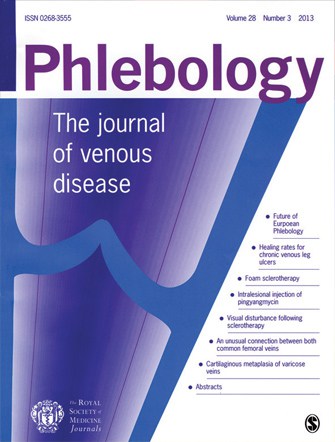
Phlebology OnlineFirst published on 20 May 2014 as DOI: 10.1177/0268355514535927
Corresponding author:
MS Whiteley MS FRCS(Gen)
The Whiteley Clinic
Stirling House, Stirling Road
Guildford, Surrey GU2 7RF, UK
Email: [email protected]
Phleboloby 0(0) 1-4
© The Author(s) 2014
Reprints and permissions:
sagepub.co.uk/journalsPermissions.nav
DOI: 10.1177/0268355514535927
phl.sagepub.com
We have previously reported striptrack revascularization 1 year following high saphenous ligation and inversion stripping. This study reports the 5-8 year results in the same cohort.
Between 2000 and 2003, 72 patients presented with primary varicose veins and had undergone high saphenous ligation and inversion stripping plus phlebectomies with or without subfascial endoscopic perforator surgery. Of the 64 patients who had attended for follow-up at 1 year, 35 patients (male:female 16:19; 39 legs) underwent duplex ultrasonography 5-8 years after surgery (response rate) 55%. Duplex ultrasonography was performed and all strip-tract revascularization and reflux and groin neovascularization was documented.
Eighty-two per cent of legs of patients showed some evidence of strip-tract revascularization and reflux. Full and partial strip-tract revascularization and reflux was seen in 12.8% and 59% of limbs of patients, respectively, and 10.2% limbs of patients had neovascularization only at the saphenofemoral junction only. Seven limbs of patients showed no revascularization.
Five to eight years after high saphenous tie and stripping, 82% of legs of patients showed some strip-tract revascularization and reflux and 12% showed total revascularization and reflux of the stripped great saphenous vein.
Alexandra E Ostler (The Whiteley Clinic Summer Research Fellow 2013)
Judy M. Holdstock (Chief Vascular Technologist at The Whiteley Clinic)
Charmaine C Harrison (Senior Vascular Technologist at The Whiteley Clinic)
Barrie A. Price (Consultant Surgeon at The Whiteley Clinic)
Mark S. Whiteley
Phlebology published online 20 May 2014. DOI: 10.1177/0268355514535927
Since 1999, all The Whiteley Clinic patients have been advised against stripping and have been recommended endovenous thermoablation (radiofrequency or laser depending on which device is most suitable). Initially this was thought to be radical. However, over the last decade and a half, more doctors and insurance companies have started adopting The Whiteley Clinic’s view. In July 2013, NICE even enshrined this in the NICE clinical guidelines for varicose vein surgery CG168
This study was a follow up of our 1 year results after varicose vein stripping.
We found that 5-8 years after stripping of the Great Saphenous Vein for varicose veins, 82% of treated legs showed re-growth of the veins that had been stripped. In 12.8% the whole vein had grown back and in 59% sections had re-grown.
None of these re-grown veins had developed any valves and so all of them were showing venous reflux – the cause of recurrent varicose veins, phlebitis, swelling and venous skin damage.
Stripping of the great saphenous vein aims to stop venous reflux by removing the incompetent veins that allow blood to reflux back down them. This refluxing blood in the veins causes the varicose veins.
After 5-8 years the stripping operation had failed in 82% of legs due to the veins growing back again and being incompetent.
This does not happen after endovenous thermoablation if it is performed using the Whiteley Protocol.
This justifies why since 1999 The Whiteley Clinic has recommended that no patients have stripping of the Great Saphenous Vein.
Scientists have been trying to grow veins for years for bypass surgery. It turns out that the body does this very well itself as part of the healing process after stripping.
Unfortunately this is exactly the reverse of what we are trying to achieve in varicose vein surgery!