
Unveil the Hidden Causes of Varicose Veins for Permanent Treatment Results
February 19, 2026
PUBLISHED BY
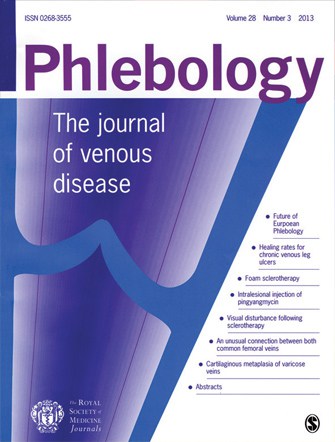
Whiteley-Patel Technique for making foam sclerotherapy for the treatment of varicose veins published in Phlebology
Phlebology OnlineFirst published on October 6, 2014 as doi:10.1177/0268355514554476
1The Whiteley Clinic, Stirling House, Guildford, Surrey, UK
2Faculty of Health and Biomedical Sciences, University of Surrey, Guildford, UK
Corresponding author:
MS Whiteley MS FRCS(Gen)
The Whiteley Clinic Stirling House, Stirling Road Guildford, Surrey GU2 7RF, UK
Email: [email protected]
The longevity of foam made using sodium tetradecyl sulphate and gas (air or a CO2:O2 mixture) is increased significantly if silicone-free syringes are used over the normal syringes containing silicone oil lubrication. However, the plungers in silicone-free syringes start sticking after several passages when making foam for sclerotherapy, preventing the smooth injection of the resulting foam. We describe a three syringe technique which allows foam to be made using the Tessari Tourbillon ‘three-way stopcock’ principle between two syringes, but with the foam ending up in a third syringe which has not undergone multiple passages of the plunger. This allows a smoother injection of the resultant foam, which is particularly useful when injecting small diameter veins under ultrasound control.
This is a new technique, invented at The Whiteley Clinic by Mark Whiteley and Salil Patel to make sure that the foam made and given to patients is optimised to give the best results.
Previous research from The Whiteley Clinic has shown that foam for sclerotherapy can be made better if silicone free syringes are used. Also, for safety, air should not be used. Nonsilicone syringes stick after making foam – so a 3 syringe technique was devised to ensure the injecting syringe is undamaged at the time of injection.
The Whiteley-Patel 3 syringe technique is a modification of the Tessari 2 syringe technique that allows foam to be produced in the research proven optimal manner, and then injected without the syringe sticking.
The pressures generated in making the foam mean a special silicone free syringe with a Luer Lock end is needed – several ties were ruined in discovering the optimal configuration.
Mark S. Whiteley
Salil B. Patel (The Whiteley Clinic Summer Research Fellow 2013 & Medical Student)
See: http://www.ncbi.nlm.nih.gov/pubmed/25288590
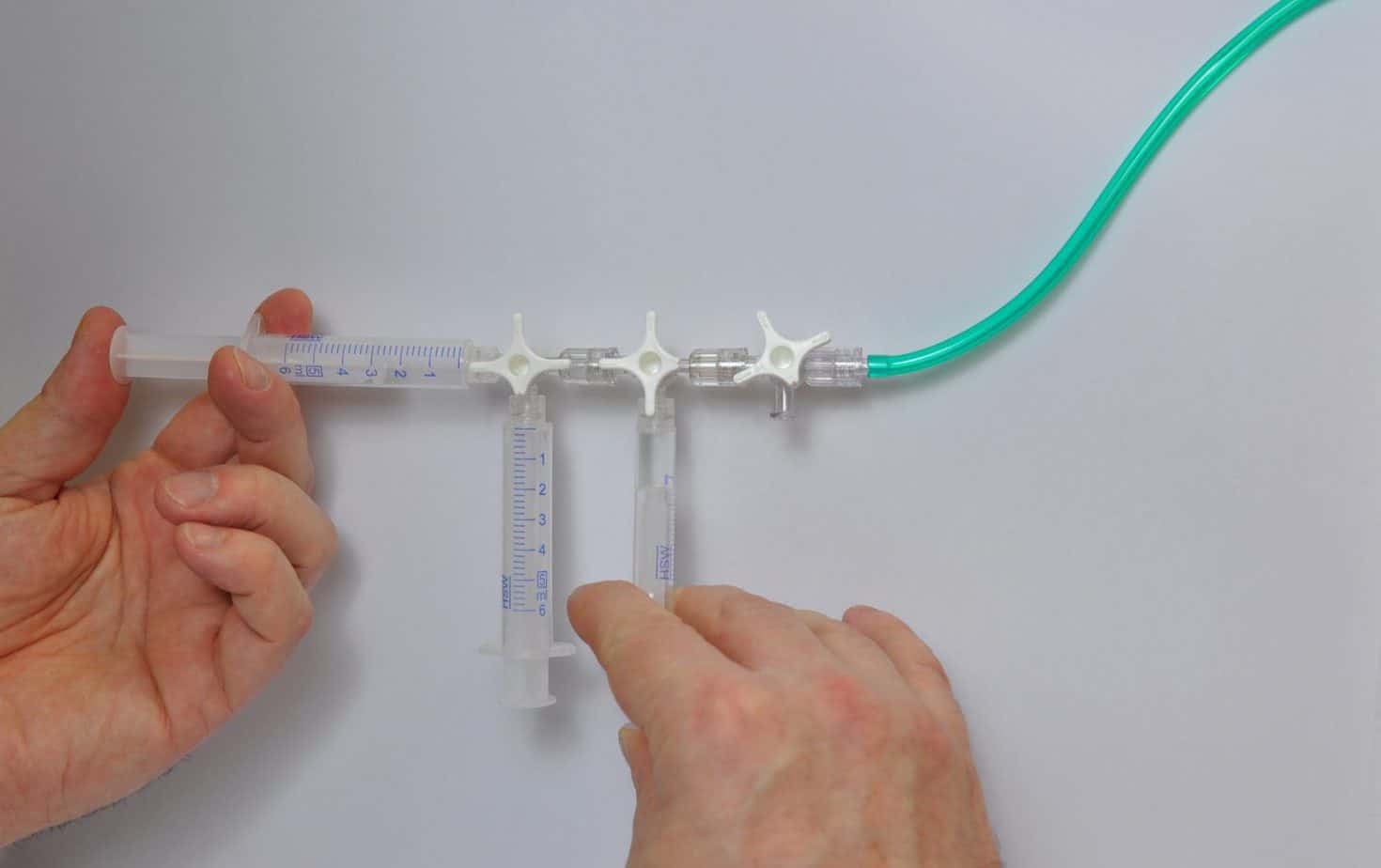
Whiteley-Patel Technique for making foam sclerotherapy for the treatment of varicose veins
The Whiteley-Patel technique allows The Whiteley Clinic doctors to manufacture our research proven foam for sclerotherapy.