
Recurrent Varicose Veins
Recurrent Varicose Veins can develop when the original cause of venous reflux was not fully identified, when the affected veins were not treated with the most appropriate technique, or when new venous disease develops over time. A detailed venous duplex ultrasound scan is therefore essential for identifying the source of reflux, including possible pelvic or perforator vein involvement. The Whiteley Protocol® uses this detailed assessment to create an individualised treatment plan, selecting the most appropriate minimally invasive treatment for each affected vein and reducing the risk of further recurrence.
What causes Recurrent Varicose Veins?
Varicose veins do not always begin at the top of the great or small saphenous vein. Research associated with The Whiteley Clinic showed that valve failure can begin lower down the vein and then progress upwards over time. The upper part of the vein may therefore become involved later rather than acting as the original source of the problem.
This is important when assessing Recurrent Varicose Veins because treating only the most obvious or familiar vein may leave the underlying source of reflux untreated.
Further research has identified incompetent perforating veins as a potential source of recurrent disease. Pelvic venous reflux can also contribute to recurrent varicose veins, particularly in women. Other veins, including accessory saphenous veins, can also contribute to the pattern of venous reflux.
As a result, Recurrent Varicose Veins do not have a single cause. The pattern of venous disease can differ considerably between patients.

Why can varicose veins return after treatment?
There are three main reasons why varicose veins may return after treatment:
- The wrong veins were treated.
- The correct veins were treated, but the technique was not appropriate for the vein.
- New varicose veins developed because additional valves failed over time.
Each cause requires a different approach. Detailed diagnosis and appropriate treatment can often address the first two causes. The third reflects natural disease progression, which treatment cannot completely prevent.
The importance of a detailed duplex ultrasound scan
A visible varicose vein is usually a sign of an underlying venous problem rather than the original source of reflux. Therefore, successful treatment starts with identifying where abnormal blood flow begins.
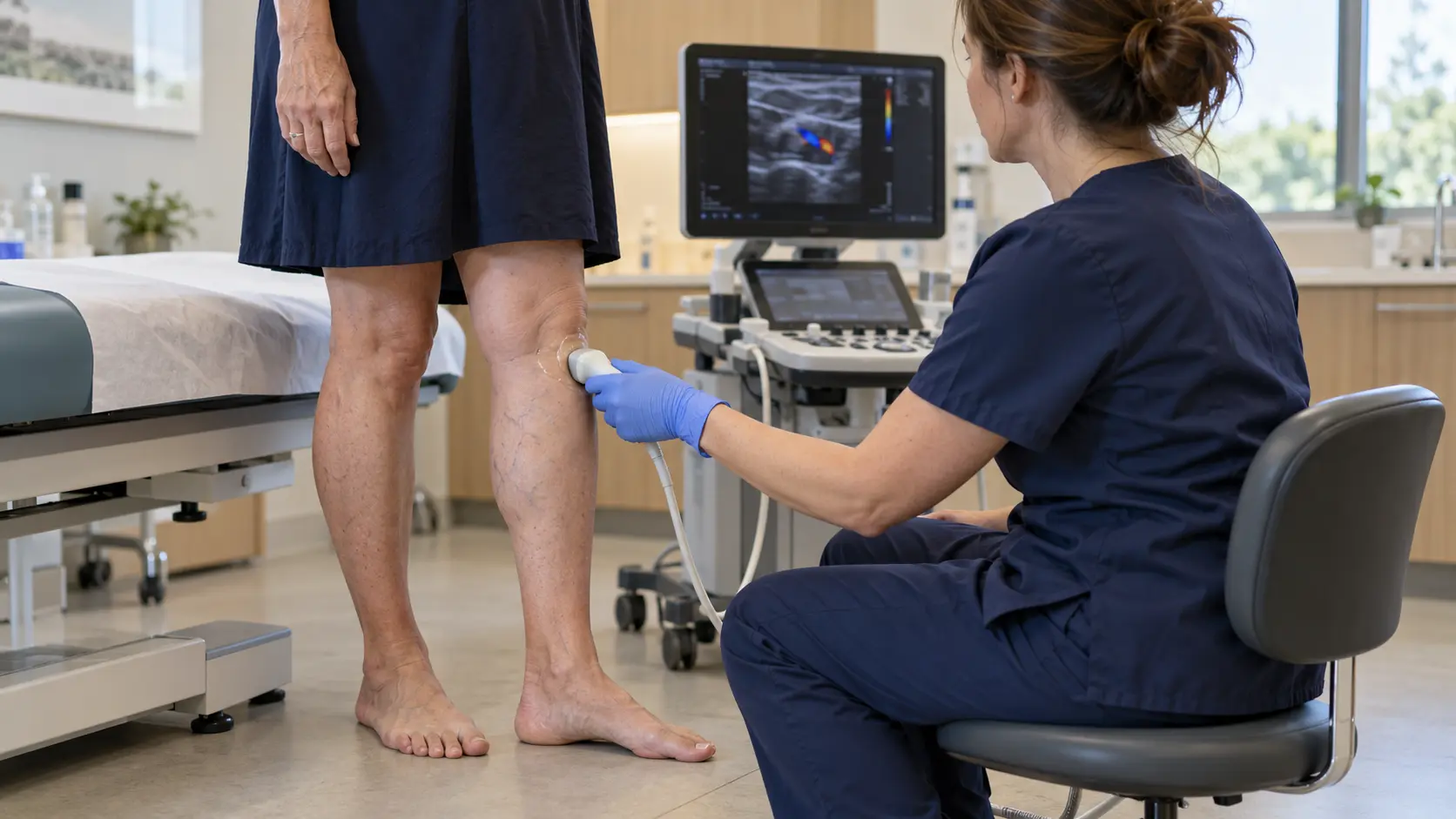
A comprehensive venous duplex ultrasound scan can map the veins, identify reflux and show which veins contribute to the visible varicose veins. This is particularly important in Recurrent Varicose Veins because previous treatment may have altered the anatomy and created scar tissue.
The Whiteley Protocol® uses a detailed duplex assessment performed by specialist Vascular Scientists trained to investigate the full pattern of venous disease. The assessment does not focus only on the great and small saphenous veins. It also considers accessory veins, perforating veins and, where appropriate, the pelvic veins.
NICE recommends duplex ultrasound to confirm the diagnosis, determine the extent of truncal reflux and help plan treatment in people with suspected primary or recurrent varicose veins.
A detailed scan is therefore not simply a preliminary test. It forms the basis of the treatment plan.

When should the pelvic veins be investigated?
Pelvic venous reflux can contribute to Recurrent Varicose Veins, particularly when the pattern of reflux cannot be fully explained by the veins in the legs.
Research from The Whiteley Clinic found a significant association between pelvic venous reflux and recurrent varicose veins in women.
For this reason, the pelvic veins may need assessment when the clinical history and duplex findings suggest a pelvic source. The Whiteley Clinic has developed a protocol for assessing pelvic veins using transvaginal duplex ultrasound where appropriate.
If pelvic reflux contributes to the disease, pelvic vein embolisation may form part of the treatment plan. This allows the underlying source of reflux to be addressed rather than treating only the visible veins in the leg.
Why one treatment does not suit every vein
Recurrent Varicose Veins often involve a combination of abnormal veins. These veins can differ in size, location, anatomy and pattern of reflux. Therefore, using one treatment for every patient or every vein is unlikely to provide the best outcome.
The Whiteley Protocol® follows a tailored approach. The treatment selected depends on the findings of the duplex ultrasound assessment and the individual pattern of venous disease.
Current treatment options available through The Whiteley Clinic include:
- Endovenous laser ablation (EVLA) for appropriate refluxing veins
- High Intensity Focused Ultrasound (HIFU) in suitable cases
- Ultrasound-guided foam sclerotherapy
- Pelvic vein embolisation when pelvic reflux contributes to the condition
- Transluminal Occlusion of Perforators (TRLOP) for suitable incompetent perforating veins
- Ambulatory phlebectomy for larger superficial varicose veins
- Microsclerotherapy where treatment of smaller residual surface veins is appropriate
The Whiteley Clinic currently describes treatment as a staged process. The first stage targets the underlying source of venous reflux. Subsequent treatment can address remaining varicose veins and, where necessary, smaller surface veins. This approach avoids trying to treat every component of the disease with a single procedure.
How can the right treatment reduce recurrence?
Identifying the correct veins is only part of successful treatment. Each vein also requires an appropriate technique.
Research and clinical experience at The Whiteley Clinic have examined how different venous conditions respond to different treatment approaches. Studies have included the treatment of pelvic venous reflux, incompetent perforating veins and the optimisation of foam sclerotherapy. Research has also examined treatment considerations in patients with complex venous conditions and different tissue characteristics.
Further work has investigated factors that influence foam sclerotherapy and the production of treatment foam, helping to inform the development and refinement of treatment protocols.
The principle is straightforward: the treatment should match the vein and its underlying pathology.
This is particularly relevant in Recurrent Varicose Veins. Previous procedures may leave scar tissue, altered anatomy or residual abnormal veins. A treatment plan therefore needs to account for both the current anatomy and the reason the veins have returned.
What treatments are used for Recurrent Varicose Veins?
Modern management focuses on minimally invasive treatment rather than repeating traditional open surgery.
For suitable refluxing truncal veins, endovenous laser ablation can close the abnormal vein from inside. Other veins may require different approaches. Incompetent perforating veins can be treated with TRLOP, while larger superficial varicose veins may require ambulatory phlebectomy. Ultrasound-guided foam sclerotherapy can treat suitable residual or smaller refluxing veins. Where pelvic reflux contributes to the condition, pelvic vein embolisation may be appropriate.
NICE recommends endothermal ablation for suitable patients with confirmed varicose veins and truncal reflux. If endothermal ablation is unsuitable, NICE recommends ultrasound-guided foam sclerotherapy.
Treatment decisions depend on the pattern of venous disease found during assessment. Since veins can differ in size, anatomy and reflux, Recurrent Varicose Veins may require more than one treatment technique.
What about new varicose veins after successful treatment?
Not every new varicose vein represents failure of the original treatment.
Some patients develop new venous disease because valves that were functioning normally at the time of treatment later become incompetent. This process is known as de novo varicose veins or disease progression.
The Whiteley Clinic reports an annual rate of approximately 3–4.5% for the development of new varicose veins following treatment. This reflects the natural progression of venous disease rather than failure of the previously treated vein.
This distinction matters. A new varicose vein can develop from a previously healthy vein even when the original source of reflux has been successfully treated.
Long-term monitoring can therefore play an important role. The Whiteley Clinic's Leg MOT programme uses specialist duplex ultrasound to monitor previously healthy veins and identify new or hidden venous disease at an early stage.
Can Recurrent Varicose Veins be treated successfully?
Recurrent Varicose Veins can be more complex than primary varicose veins because previous treatment may have changed the venous anatomy. However, complexity does not necessarily mean that treatment is impossible.
The key is to identify the complete pattern of reflux before selecting a treatment. A comprehensive duplex ultrasound assessment can reveal the veins responsible for the recurrence, while assessment of the pelvic veins may identify an additional source when appropriate.
The Whiteley Protocol® brings these elements together. It combines detailed investigation, diagnosis and personalised treatment planning. The aim is to treat the underlying venous reflux with the most appropriate minimally invasive technique, rather than simply removing the veins that are visible on the skin.
For patients with Recurrent Varicose Veins, this approach provides a structured pathway from diagnosis to treatment and long-term follow-up. It also recognises that recurrence can have different causes and that new disease may develop independently over time.
The goal is therefore not simply to remove visible veins. It is to identify the source of venous reflux, treat the affected veins appropriately and reduce the likelihood of further recurrence through an individualised treatment strategy.