
Superficial temporal arteries (temple arteries)
Temple arteries can become increasingly visible across the sides of the forehead and temples. They may stand out more during exercise, hot weather or periods of increased blood flow. Although prominent arteries in this area are usually a cosmetic concern rather than a sign of disease, it is important to identify the vessel correctly before considering treatment. Arteries and veins have different anatomy and require different approaches. Modern assessment with duplex ultrasound can confirm the vessel involved and help determine whether treatment is appropriate.
What Are the Arteries in the Temple?
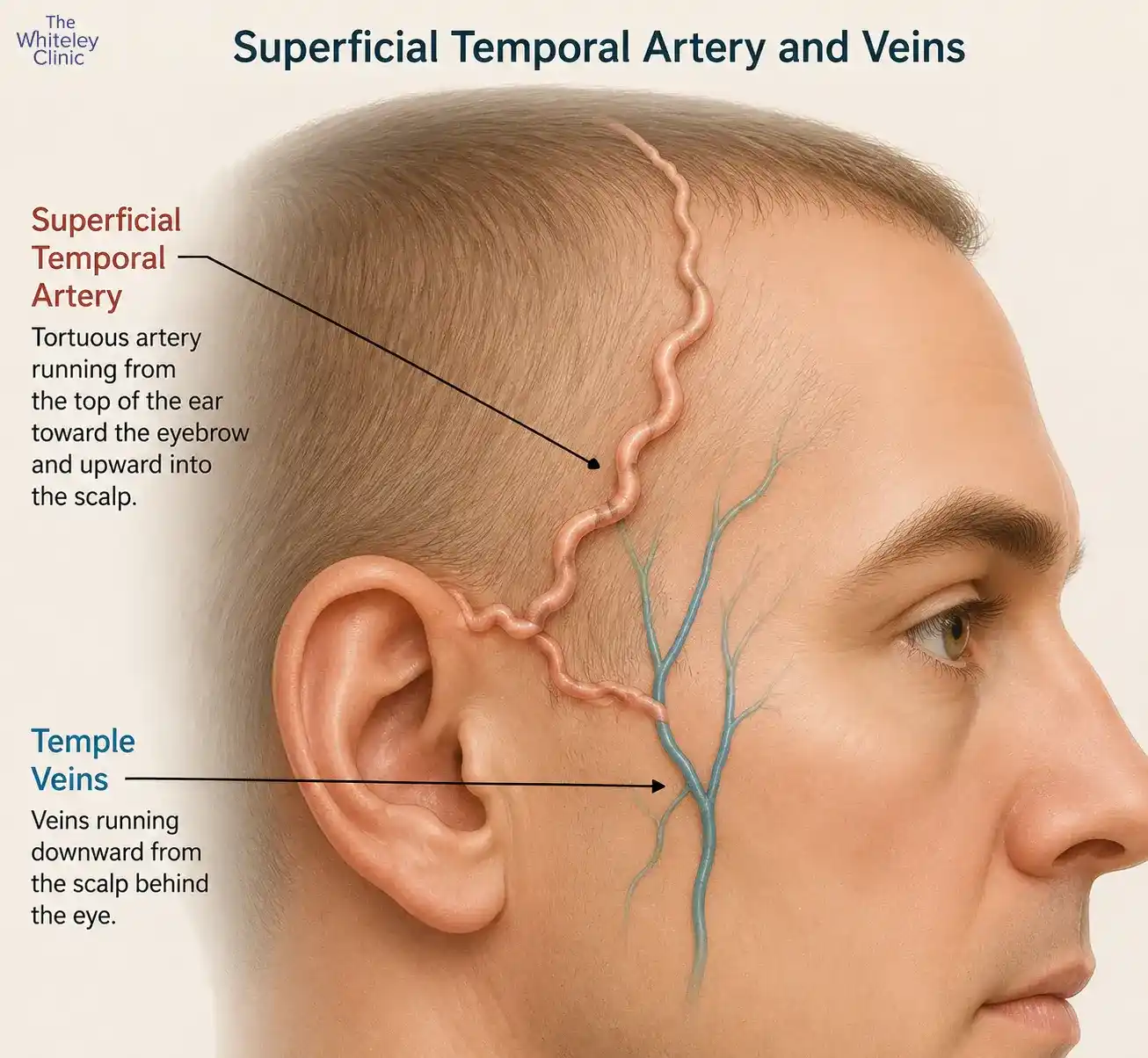
The vessels commonly described as temple arteries are the superficial temporal arteries. These are branches of the external carotid artery and supply blood to parts of the scalp and face.
The superficial temporal artery travels upwards in front of the ear before dividing into branches that supply the forehead and scalp. One of its main branches, the frontal branch, runs towards the forehead. Its exact course is not identical in everyone. Anatomical studies show considerable variation in the level at which the artery divides and in the position of its branches. This variation becomes important when specialists plan a procedure.
Because the artery can lie relatively close to the skin, it may become clearly visible in some people. It can also have a winding appearance rather than following a straight line.
Why Do Temple Arteries Become More Visible?
Temple arteries can become more noticeable when changes in blood flow, temperature or the tissues covering the vessel make it stand out beneath the skin. Several factors can contribute to this:
- Exercise: Increased cardiac output and blood flow during physical activity can temporarily make superficial arteries appear larger.
- Heat: Warm temperatures cause blood vessels to widen as part of the body's normal temperature regulation. This can make a superficial temporal artery more prominent.
- Alcohol: Alcohol can cause vasodilation, making superficial blood vessels temporarily more visible.
- Emotional excitement: Strong emotions can increase blood flow and make an already prominent artery easier to see.
- Ageing: Changes in the skin, connective tissue and facial soft tissues can reduce the coverage over superficial blood vessels, making them more noticeable over time.
- Individual anatomy: The depth, size and course of the superficial temporal artery vary between individuals. People with a more superficial or naturally prominent artery may notice it more clearly.
These changes do not necessarily indicate an underlying vascular problem. In many cases, the artery simply becomes more visible under certain conditions.
How Can You Tell If a Temple Vessel Is an Artery or a Vein?
A visible vessel around the temple is not necessarily an artery. Temple arteries usually have no blue or green colour and may show a visible or palpable pulse. Veins in the same region are more commonly blue or green and do not pulsate.
However, these features cannot always provide a definite diagnosis. Arteries and veins can occur close together, and their appearance may vary between individuals.
A specialist can use high-resolution duplex ultrasound to identify the vessel and assess its direction, depth and relationship with nearby structures. This is particularly useful before treatment because the superficial temporal artery has a variable anatomy and forms connections with other vessels.
Are Prominent Temple Arteries Dangerous?
In most cases, a clearly visible superficial temporal artery is not dangerous. The main concern is often cosmetic, particularly when the vessel becomes more prominent during exercise or everyday facial expressions.
However, not every new swelling in this area should automatically be assumed to be a normal artery. A new painful, rapidly enlarging or unusually pulsatile lump may require medical assessment to exclude less common vascular conditions, such as a superficial temporal artery aneurysm or pseudoaneurysm.
Other symptoms can also change the clinical picture. A new temporal headache, scalp tenderness, jaw pain while chewing or visual symptoms require prompt medical assessment because they can occur with inflammatory conditions affecting the temporal arteries.
For this reason, specialists should assess any persistent or unusual changes rather than treating them based solely on their appearance.
Why Is Ultrasound Important Before Treatment?
The anatomy of the superficial temporal artery is more complex than its appearance on the skin might suggest. Its branches can follow different paths, and the artery has connections with other arteries supplying the forehead and scalp.
Duplex ultrasound provides real-time information about the vessel. It can confirm whether the prominent structure is arterial or venous and can show its course beneath the skin.
This information allows treatment to target the correct vessel while reducing the risk of treating an adjacent structure. Ultrasound is therefore particularly valuable when the visible vessel is close to important facial and scalp anatomy.
What Treatments Are Available for Prominent Temple Arteries?
Treatment is usually considered for cosmetic reasons rather than because the artery needs medical treatment.
Historically, simple surgical ligation was used to stop blood flow through a prominent artery. However, collateral vessels can maintain blood flow around a ligated segment. More targeted approaches have therefore been developed.
One option is duplex-guided double ligation, a technique described for prominent frontal branches of the superficial temporal artery. Ultrasound helps locate the artery before very small skin openings are made. The aim is to deal with the selected arterial segment while limiting unnecessary disruption of the surrounding tissue.
Another developing approach uses endoluminal thermal ablation. A recent case report described ultrasound-guided treatment of a prominent frontal branch of the superficial temporal artery using a 1470-nm laser. The reported result was encouraging, but the evidence currently comes from an individual case rather than a large clinical study. Therefore, this approach should be regarded as an emerging technique rather than an established standard of care.
Why Is Sclerotherapy Not Used for Temple Arteries?
Sclerotherapy primarily treats veins, so it is not suitable for prominent temple arteries. The procedure involves injecting a sclerosant into a vein to damage its lining and encourage the vessel to close. A superficial temporal artery has a different structure and carries blood under arterial pressure, so treating it with a sclerosant is not an appropriate alternative to arterial treatment.
There is also a particular safety concern in the temple and forehead region. The superficial temporal artery has connections with other vessels supplying the face and scalp, while facial vessels can also communicate with the circulation around the eye. Accidental injection of a sclerosant into an artery can cause tissue ischaemia, and clinicians have reported rare cases of severe visual complications following facial sclerotherapy.
For this reason, a specialist should identify the prominent vessel before considering any injection treatment. Duplex ultrasound can distinguish a temporal artery from a vein and show its course beneath the skin. If the prominent vessel is an artery, specialists should consider a targeted arterial treatment rather than sclerotherapy.
Why Are Temple Arteries Different From Forehead Veins?
Prominent vertical vessels in the centre of the forehead may sometimes be veins rather than arteries. In particular, the supratrochlear veins can become visible and may require a different treatment strategy.
Researchers have investigated endovenous laser treatment for prominent supratrochlear veins, and more recent clinical experience supports its use in carefully selected patients. However, these findings relate to veins and do not show that the same treatment has become established for temple arteries.
Correct identification of the vessel is therefore the first step towards selecting an appropriate treatment.
What Happens During a Specialist Assessment?
Assessment normally begins with an examination of the visible vessel and the surrounding area. The specialist considers its colour, shape, pulsation and behaviour during activities such as exercise.
Duplex ultrasound can then provide a more detailed assessment when required. The findings help establish whether the vessel is an artery, vein or another vascular abnormality.
If treatment is appropriate, the choice of technique depends on the vessel's anatomy, size, position and relationship with nearby structures. This individualised approach is particularly important in the temple because superficial vessels have variable courses and important arterial connections.
Can Prominent Temple Arteries Be Treated?
Yes. Although temple arteries are usually harmless, their appearance can cause significant cosmetic concern. Modern techniques allow specialists to treat selected prominent arteries with targeted procedures, often using local anaesthetic and very small access points.
The most appropriate option depends on the individual anatomy and the findings of the assessment. Duplex ultrasound can play an important role in making that decision and in guiding treatment safely.
A specialist vascular assessment is therefore the appropriate starting point for anyone concerned about a persistent or newly prominent artery around the temple or forehead.