

How Can You Effectively Treat Calluses and Corns on Feet?
August 15, 2026
Bulging temporal arteries are a common concern for many people, particularly when they appear on the temples or forehead. Although these blood vessels do not usually cause medical problems, many people find them cosmetically troubling, which often leads them to seek effective treatments. With advanced techniques now available, patients can explore safe and effective treatments for these visible vessels as well as other Facial vein conditions. This article explains what they are, how they differ from veins, and which modern treatment options can restore confidence and comfort.
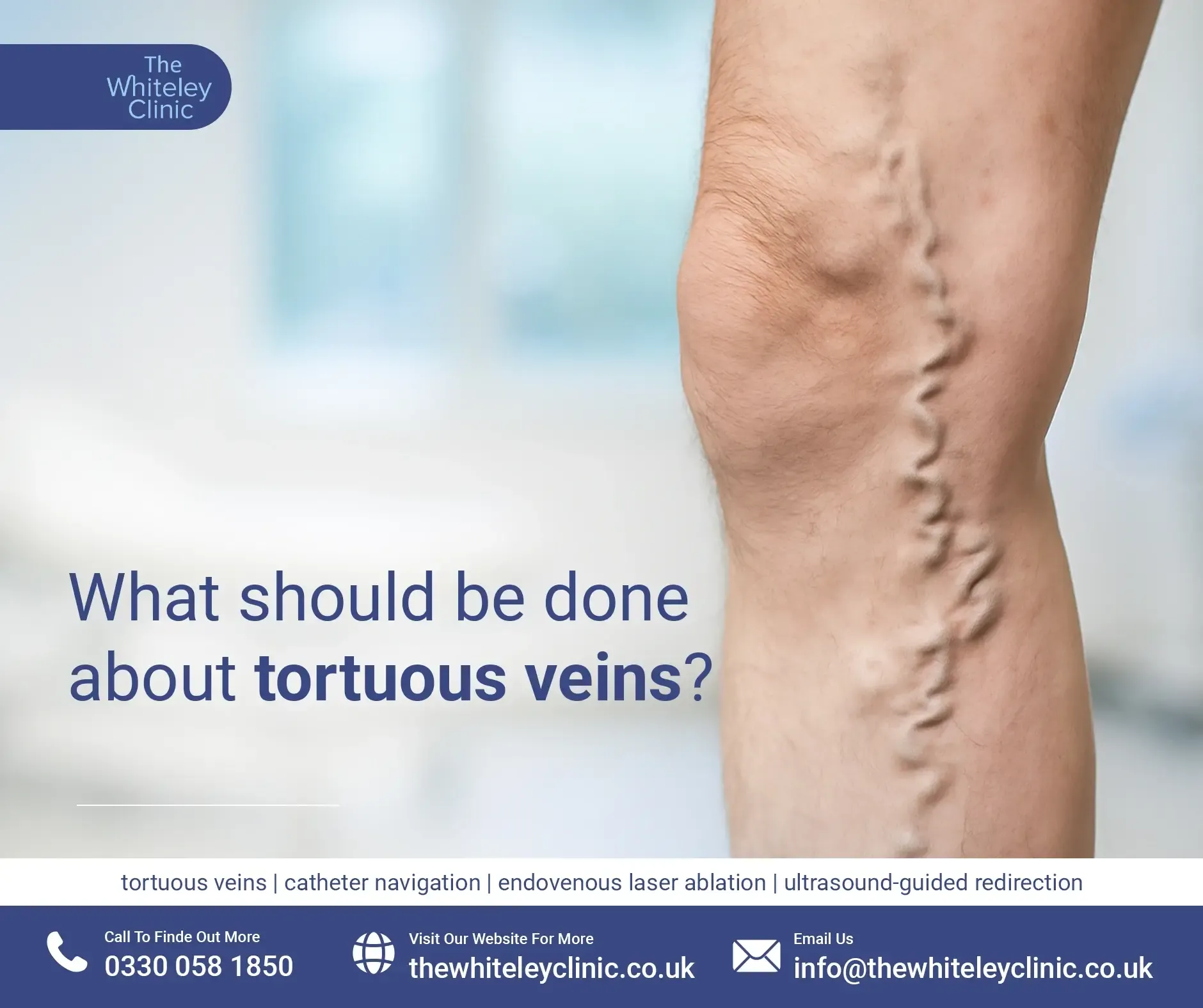
The temporal arteries supply blood to the scalp and run across the temples. In some individuals, these vessels become more prominent, especially during exercise or in hot conditions. Unlike veins, which usually appear blue or green and remain straight, they often appear tortuous. They twist and bulge, giving them a wavy appearance that can draw unwanted attention.
While visible arteries are not considered a medical risk, many patients find them aesthetically unappealing. Consequently, they seek solutions that provide lasting cosmetic improvement.
The prominence of these arteries is partly due to their anatomical position. They run close to the surface of the skin in the temple area, making them more visible than deeper vessels. As connective tissue and skin elasticity reduce with age, the vessels become more noticeable. Increased blood flow during exercise, heat exposure, or stress further enlarges them, causing temporary bulging. Genetic factors may also contribute, explaining why some individuals are more prone to visible temporal arteries than others.
Clinicians must distinguish temporal arteries from other vessels, such as facial veins, to ensure accurate treatment. Veins in the face often appear smaller, straighter, and bluish in colour, while these arteries have no distinct colour but are easy to identify because they pulsate gently. In fact, with a careful touch, patients can feel the pulse of the vessel themselves.
In some cases, both veins and arteries can coexist in the same area. When this happens, clinicians usually treat the artery first and then address the veins if necessary. High-resolution duplex ultrasound scans help confirm the type of vessel, ensuring the most effective treatment plan.
Patients often wonder if laser treatments can address bulging temporal arteries. The truth is that lasers are effective for small blue or red veins but not for arteries. The structure of arteries makes them resistant to laser energy. As a result, non-surgical methods alone are usually ineffective for temporal arteries.
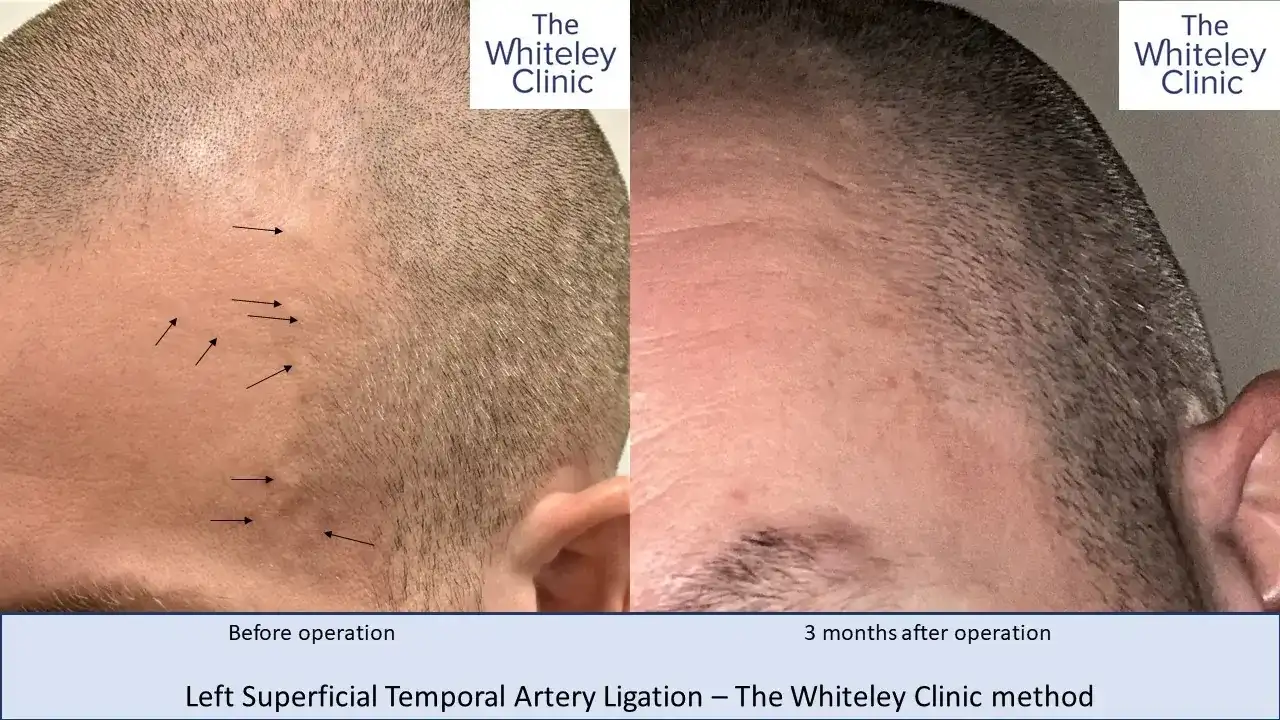
For larger and more prominent vessels, surgical removal provides the most reliable results. This procedure is delicate, particularly when performed on the face or temples. However, with modern minimally invasive methods, patients can achieve excellent outcomes with little to no scarring.
Professor Mark Whiteley and his team have pioneered advanced methods to treat temporal arteries safely and effectively. The procedure is performed under local anaesthetic, which ensures patient comfort and avoids the risks of general anaesthesia.
Using high-resolution duplex ultrasound, the surgeon carefully maps the artery before making extremely small incisions. These incisions are so minimal that they do not require stitches. By removing or destroying the artery, the bulge disappears, leaving the skin smoother. Because the scalp has a rich blood supply, eliminating one artery does not compromise overall circulation.
When treating temporal arteries, it is important to consider the surrounding vascular network. The scalp and facial regions are supplied by numerous branches of both the external and internal carotid arteries. Removing or closing a single temporal artery does not compromise blood supply, as collateral circulation compensates effectively. This redundancy is why modern surgical techniques are considered safe, provided they are performed by experienced specialists who use ultrasound guidance to precisely identify the vessel.
Patients choosing this advanced technique for temporal arteries experience several benefits:
These improvements make the procedure far more attractive than older methods, which involved larger incisions and stitches that often left visible scars.
Beyond temporal arteries, The Whiteley Clinic offers treatments for a variety of cosmetic vascular conditions. These include thread veins, venous lakes, cherry angiomas, and other vascular lesions on the face, scalp, and body.
For small red thread veins, Intense Pulsed Light (IPL) or Electro Surgery may be recommended. For larger bluish veins that are not bulging, Nd:Yag laser therapy can be effective. However, when veins or arteries bulge, surgical removal remains the gold standard.
Some clinics may still suggest sclerotherapy for facial veins. At The Whiteley Clinic, this approach is avoided due to safety concerns. Veins around the cheeks, temples, and forehead can drain into the eye socket. Injecting sclerosant in these areas poses a rare but serious risk of complications affecting the eyes or brain. Therefore, sclerotherapy is only considered in exceptional circumstances.
Every patient is unique. At The Whiteley Clinic, consultations ensure that the correct diagnosis is made and that the most appropriate treatment is chosen. During your consultation, you will receive a personalised plan, guidance on recovery times, and advice on how to prepare before and after the procedure.