Thread Veins (Spider Veins)
What are Thread Veins and where can they occur?
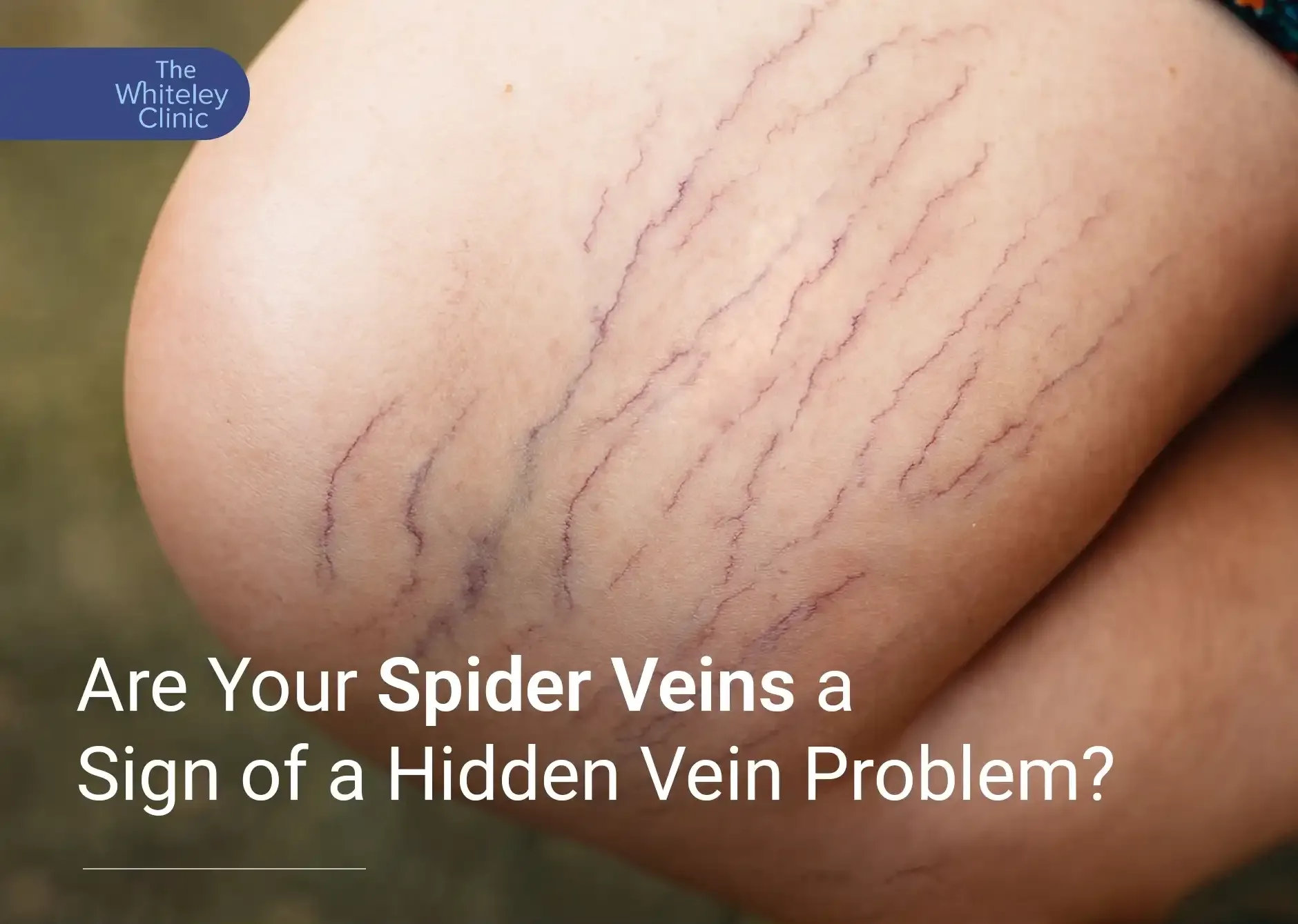
Thread veins on the leg and the face – also commonly referred to as ‘spider veins’, ‘broken veins’, ‘surface veins’ or ‘venous flares’ – are small blood vessels in the most superficial layer of the skin (the dermis) which have become dilated and visible. Generally, the dermis is about 2-3 mm thick, so the deeper-seated the thread vein is in the skin, the less distinct and ‘livid’ it looks, and vice versa. Thread veins are very common, affecting around 80% of adults (evenly split across both sexes) at some point in life and they are usually associated with underlying vein problems.
At The Whiteley Clinic, we specialise in the treatment of thread veins on the legs, and thread veins on the face.
Thread veins on the legs differ in two key respects from thread veins on the face
Firstly, thread veins on the face are, obviously, much higher up the body than the heart whereas thread veins on the leg are below the position of the heart, and this crucial difference in position relative to the heart changes how we approach the two distinct types of thread veins.
Gravity alone should make it easy for thread veins on the face to drain blood away down to the heart. So, the very fact they are ‘open’ with blood visible inside them would indicate that the reason for the thread veins to appear is that they probably have some arterial pressure within the vein.
Contrast this with thread veins on the legs which, being below the heart, become visible because they often have a ‘column’ of blood above them, keeping them open and filled when standing or sitting. That’s why, following The Whiteley Protocol®, we always perform a scan to identify the location of that column of blood before attempting to treat the thread veins themselves.
Secondly, the very nature of the surrounding skin on the face and legs is totally different. The skin on the face is always open to the elements and is very resistant to the sun, heat and radiation. It has a great blood supply and heals quickly and well.
However, the skin on the legs is usually hidden away and protected under clothes, making it much more sensitive to heat and radiation. Plus, the skin on the legs does not have as good a blood supply as the face, making the healing process slower and more difficult. This is a key factor in the recovery times from, say, strong laser treatment, which can leave permanent scars.
These two key differences influence the ways that we investigate, diagnose and treat thread veins on the face and legs. Key to our approach is, first, to find out what is going on beneath the skin with a scan. And as specialists in venous problems, we look for treatments beyond simply addressing the veins on the surface (which does not usually give good results in the long term, with thread veins coming back after treatment) or risking skin scarring from utilizing the wrong treatment methods.
What Causes Thread Veins?
In a nutshell, the precise causes of the venous dilation that causes thread veins on the legs are not fully known. Visiting our competitors’ websites and reading their brochures reveals a wealth of conflicting theories and misinformation concerning this condition. However, the data and insights collated by The Whiteley Clinic over the course of our years of empirical clinical experience affords us the clearest overview of the facts around thread veins.
In many ways, it is easier to cite those factors which can be proven not to cause thread veins. We have read papers claiming that different skin types are more prone to thread veins on the legs. However, this is easily debunked by virtue of the fact that we have treated numerous cases of thread veins in all different skin types, from the palest skins which never tan to the very darkest skins.
Other sources claim that thread veins are ‘broken capillaries’, with the damage caused by crossing the legs, wearing tight clothes or boots and even taking baths that are too hot! None of this makes sense. If a patient really did have ‘broken capillaries’, they would present not with thread veins but with widespread bruising. Crossing the legs has no effect at all on the venous system as the veins are deep-seated and protected by muscles and tendons. Tight fashion and footwear is easily discounted by the variety of locations of thread veins all across the legs – it’s not a condition that predominantly occurs in the ankles or waistband. And as for taking hot baths, if that were true, the condition would be far, far more widespread across the cleaner sections of the UK population.
Facts about thread veins
Turning to the facts about the condition, which we can assert to be true, there does seem to be a familial link with thread veins occurring not just amongst parents and children but also amongst siblings (a similar statistical genetic link has also been observed amongst Varicose Vein sufferers).
One cause of profuse thread veins that has consistently been observed is trauma, particularly in the case of patients who have been in severe accidents where skin has been crushed, where fat has been destroyed and where surgical scarring is extensive. Whilst, thankfully, this kind of extreme trauma only accounts for only a very small proportion of the overall number of thread veins cases seen at The Whiteley Clinic, the link is undeniable.
Research into venous conditions by The Whiteley Clinic and others has also shown that the majority of thread veins on the legs (in up to 90% of cases) are associated with underlying ‘feeding veins’ or hidden varicose veins. Whilst we cannot be certain that they are actually causing the thread veins, it is becoming clearer that if we don’t first identify and treat the ‘feeding veins’ and hidden varicose veins, then the results of the thread veins treatment itself seem to be far less successful.
It is worth mentioning a particularly unsightly condition called ‘talengetic matting’ where the thread veins go wild after treatment causing profuse dense red patches of thread veins that are susequently almost impossible to treat. Following The Whiteley Protocol®, our policy of scanning every patient for underlying ‘feeding veins’ and hidden varicose veins has resulted in us NEVER having a case of talengetic matting. However, we regularly see talengetic matting in patients coming to us from other clinics, and in every case we have always found an underlying ‘feeding vein’ or hidden varicose vein that was neither identified nor treated prior to dealing with the thread veins.
What Are The Symptoms of Thread Veins?
The visible symptoms of thread veins appear as many different sorts of marks and depths of colour on the legs, depending on the size and distribution of the thread veins themselves. Vein walls are naturally white, so if they are empty of blood, thread veins are not seen at all under the skin.

But once they fill with blood, thread veins can range from being so small and pink that they can look like an early bruise on the leg to being so large and dark blue that they resemble the blue veins in a Stilton!
The colour of the thread vein depends on the size of the vein itself; whether the blood within is flowing or stationary; and its depth relative to the surface of the outermost ‘dermis’ layer of the skin.
Very thin thread veins can appear to be red or pink, because the blood flows through them fairly well. And if they are very near the surface of the skin, the colour of the blood is seen as the colour of the vein. If these very thin thread veins lie much deeper, then they are not seen at all from the surface.
When thread veins are larger in size, blood flows more slowly within them, giving up more oxygen as it does and so they appear darker red. In some thread veins, especially those nearing 1mm in diameter, a layer of blood can clot and stick onto the thread vein wall. This layer of clotted blood (or ‘thrombus’ as it is known) causes the thread vein to look much darker still – usually dark purple or dark blue if near the surface.
The depth of the vein under the surface of the skin also has an effect on the colour of the thread vein. When the thread vein is very near to the surface, it can be seen clearly and the colour is bright. The deeper the vein is in the dermis, the less distinct the vein and the more hazy the colour.
Diagnosis of Thread Veins
The first stage of diagnosing thread veins on the legs is a quick and simple visual check to identify whether red, purple or blue thread veins are present and sufficiently obvious to be worth treating. If they cannot be seen at a quick glance and are not causing any symptoms, and there are not other symptoms of vein disease (tired or aching legs, bulging visible veins, swelling ankles, red or brown stains around the ankles, previous or current thrombophlebitis) then no further investigation may be needed.
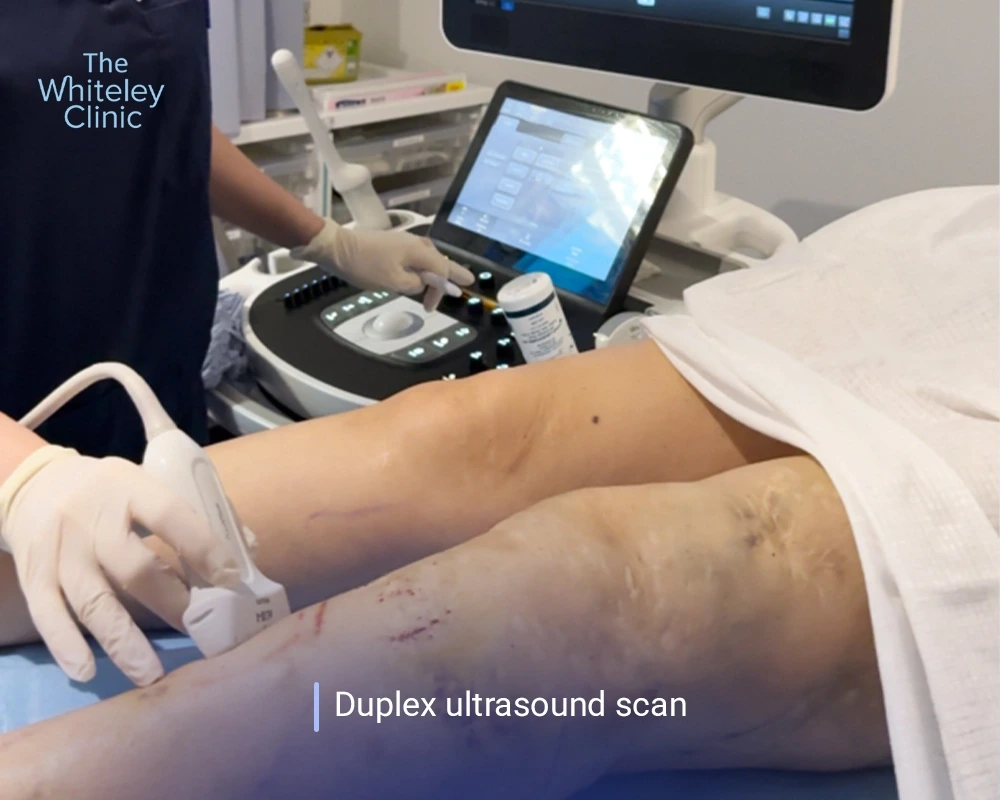
However, if treatment is required, the first step is to perform a venous duplex ultrasound scan performed by a The Whiteley Clinic-trained Vascular Scientist specialist to find out whether there are any underlying ‘feeding veins’ or hidden varicose veins. This is even more important if any of the associated symptoms listed above are present.
The venous duplex ultrasound scan is performed on the affected leg either with the patient standing, or with the body’s weight placed on the other leg, or with the patient reclining with the legs hanging down. It is impossible to perform a proper duplex ultrasound scan if the patient is lying down because the way the scan works is to observe blood falling the wrong way down the vein, due to the influence of gravity.
The Vascular Scientist will follow all of the veins in the legs, particularly those in the area of the thread veins, to build up a picture of the network of underlying veins in the area. The calf or leg below the area being tested will be manually squeezed whilst the duplex ultrasound probe is simultaneously used to observe blood flow in the veins above this point. In normal open veins, blood can be observed to flow upwards towards the heart.
The muscle will then be released to observe whether there is no backwards flow (indicating that the valves are closing normally) or whether there is backward flow – also called ‘venous reflux’ – down the veins (indicating that the valves are not working properly). By performing this test repeatedly on all of the veins in the legs, we can establish which veins are working, which ones are not, and whether the thread veins are being fed by the venous reflux and underlying veins.
Following The Whiteley Protocol®, a decision can then be made by the clinic specialist whether to treat the underlying veins first or whether the thread veins can be treated without any other procedure.
Thread Veins Treatment & Removal
There is no denying that there is a wide range of alternative treatment protocols offered to thread vein sufferers by a host of other clinics in the UK, and below you can read why they are less effective than our preferred choice of treatment.
At The Whiteley Clinic, once we have treated any underlying vein problems that may be present, we almost exclusively recommend the technique of ‘microsclerotherapy’ for the treatment of thread veins on the legs. This involves injecting a very dilute ‘sclerosant’ solution into the tiny veins to narrow the dilated blood vessels. This is achieved using an exceptionally small needle under very high magnification.
The sclerosant solution used at The Whiteley Clinic is selected for both being highly effective at narrowing the veins but also for having a numbing effect on the veins being treated, thereby reducing any potential discomfort for the patient.
Microsclerotherapy
Using The Whiteley Clinic microsclerotherapy technique, around 80% of patients report an ‘excellent result’ when the treatment has been completed, with a further 15% of patients reporting ‘good improvement’ in the visible signs. In our experience, the kind of minor problems experienced by the remaining 5% of patients (brown stains on the skin surrounding the injection site caused by a small amount of trapped blood) are almost always as a direct result of them failing to comply with our strict post-operative instructions to wear compression stockings for two full weeks, day and night! And even these minor problems are easily rectified by seeing the patient four weeks after the procedure to simply release the trapped blood.
At The Whiteley Clinic, each microsclerotherapy session is performed using a strictly controlled maximum dose of the sclerotherapy solution. If the thread veins being treated are extensive, it may be that a second procedure needs to be scheduled for the following day. It is perfectly safe to perform these two procedures in quick succession without any risk of overdose.
As noted above, for the very best results, the patient needs to wear graduated compression stockings for a full 14 days and nights after microsclerotherapy. Although many patients are tempted to remove the stockings for showers or for baths, this will undoubtedly compromise the final cosmetic result. The patients who enjoy the very best treatment results are the ones who religiously keep their stockings on without interruption for the full fortnight.
The area where the microsclerotherapy has been performed will initially look worse than it did prior to the treatment, and improvement will only start to be seen between 6 and 12 weeks later. For this reason, The Whiteley Clinic will never repeat microsclerotherapy in an area within three months as it is impossible to tell whether the visible thread veins are veins that have already treated and are in the process of disappearing. Should any thread veins remain obvious in a treated area after three months, it may then be appropriate to repeat the procedure. Even so, it is worth noting that treated thread veins continue to disappear up to 18 months after injections of microsclerotherapy.
Although The Whiteley Clinic follow very strict guidelines to get the very best results, the one thing we are unable to do is to stop new thread veins from forming on the legs.
Even when successful treatment of all the thread veins on the legs has been performed, it is still possible for new ones to appear. Sometimes, patients think that these are the same thread veins coming back again, but our clinical audits prove that this is not the case.
Whilst most of our patients experience an excellent clearance of their thread veins and go on to enjoy many years of great-looking legs, other patients are less fortunate, simply due either to their own individual biology, to specific life events such as pregnancy or even to prolonged use of the oral contraceptive pill. At The Whiteley Clinic, we advise our patients to think of thread veins in the same way as their dental health… provided you get on top of the problem – and any new problems that may appear – thread veins are something we can deal with together very easily.
Why other clinics offer less effective treatments
Because thread veins on the legs are such a common condition, it is easy for practitioners to make a lot of money, risk-free, by offering largely ineffective and short-term ‘quick fix’ treatments. The business model works like this… provided the price is low enough, expectations are low and few people ever bother to complain if they achieve a less than satisfactory result. And if they can process a sufficient volume of patients quickly, even with a low price tag, operators will be making a substantial profit. And there are simply so many people with the problem, they don’t need to worry about gaining a bad reputation because the market is so big, and there will be plenty more unsuspecting punters coming along!
As the UK’s leading venous specialists, it’s easy for us at The Whiteley Clinic to be cynical about the competition. But when you consider some of the ineffective ‘quack’ treatment options being offered to unsuspecting patients, it quickly becomes clear that, in fact, it’s not us who are the cynical ones…
Creams
There is no good evidence at all that any cream will have any lasting effect at all on thread veins on the leg. It is possible to make thread veins look better temporarily either with a formulation of cream that causes contraction of the veins, or acts as ‘cover-up’ on the skin above the veins, making them more difficult to see. But that’s not a long-term solution to getting rid of the thread veins.
Tablets or dietary supplements
Many tablets or dietary supplements boast about containing vitamin K, claiming that this ‘promotes blood clotting to help broken veins’. However, thread veins are not ‘broken’; they are merely normal veins which have become dilated, and extra Vitamin K has no measurable effect on them whatsoever.
Electrolysis or radiofrequency treatments
Many operators use devices that heat the vein by passing an electric current through a needle and, via the dermis, directly into the thread vein. This heating can indeed destroy a small section of the thread vein with each pinprick, and the immediate effect is often dramatically impressive. This is because, when the skin burns, it becomes more opaque making the thread vein simply more difficult to see through the skin. Secondly, when a thread vein is heated in one section, there is often a spasm in the vein each side of the area of treatment, causing a contraction and giving the impression that the vein has disappeared. But this spasm doesn’t last, and the treatment delivers little more than a cosmetic effect rather than a clinical solution.
As noted on our Treating Thread Veins page, thread vein on the legs lie below the heart and often have a column of blood exerting a gravitational force to keep them open. So trying to burn the visible part of the thread vein in isolation is a primitive, unsophisticated approach to a much more complex problem, and is highly unlikely to be effective. By failing to first of all treat the underlying ‘feeding veins’ or hidden varicose veins, simple electrolysis or radiofrequency treatment targeted solely at the visible branches of a cluster of thread veins will still miss any of the branches lying deeper under the skin, significantly increasing the likelihood of recurrence in the future.
Laser or pulsed light
Many clinics use laser or pulsed light devices to treat thread veins on the legs across the skin. They usually operate at a wavelength that specifically targets haemoglobin, the red pigment of blood. Although highly effective on the red vessels on the face and neck, The Whiteley Clinic does not use or recommend them for thread veins on the legs for precisely the same reason that we do not promote electrolysis or radiofrequency treatment… it fundamentally misses the vital step of treating ‘feeding’ veins or hidden varicose veins and, as such, delivers results far inferior to our chosen microsclerotherapy technique.
Additionally, with virtually every laser or pulsed light system, getting enough power into any thread vein to actually destroy it effectively seriously increases the risk of skin burns. As with electrolysis, the heated skin becomes opaque, masking the thread veins in the short term. But with laser or pulsed light, there is a very real risk that as the ‘burnt’ skin heals over the subsequent weeks, it can become either de-pigmented (whiter than the surrounding skin) or pink, shiny and ‘hyperpigmented’ (darker than the surrounding skin).
Following The Whiteley Protocol®, treatment of the thread vein clusters by microsclerotherapy overcomes all the problems noted above, enabling whole clusters of thread veins on the legs to be treated with a single injection, effectively treating both the visible and invisible parts of the thread vein cluster and delivering a far more complete treatment.