


Klippel-Trenaunay Syndrome (KTS)
March 26, 2026
Varicose veins in men occur as commonly as varicose veins in women. Many people erroneously think that women get varicose veins far more commonly than men. However, research over recent years shows this is incorrect. Varicose veins in men appear to be less common because men are worse at going to the doctors!

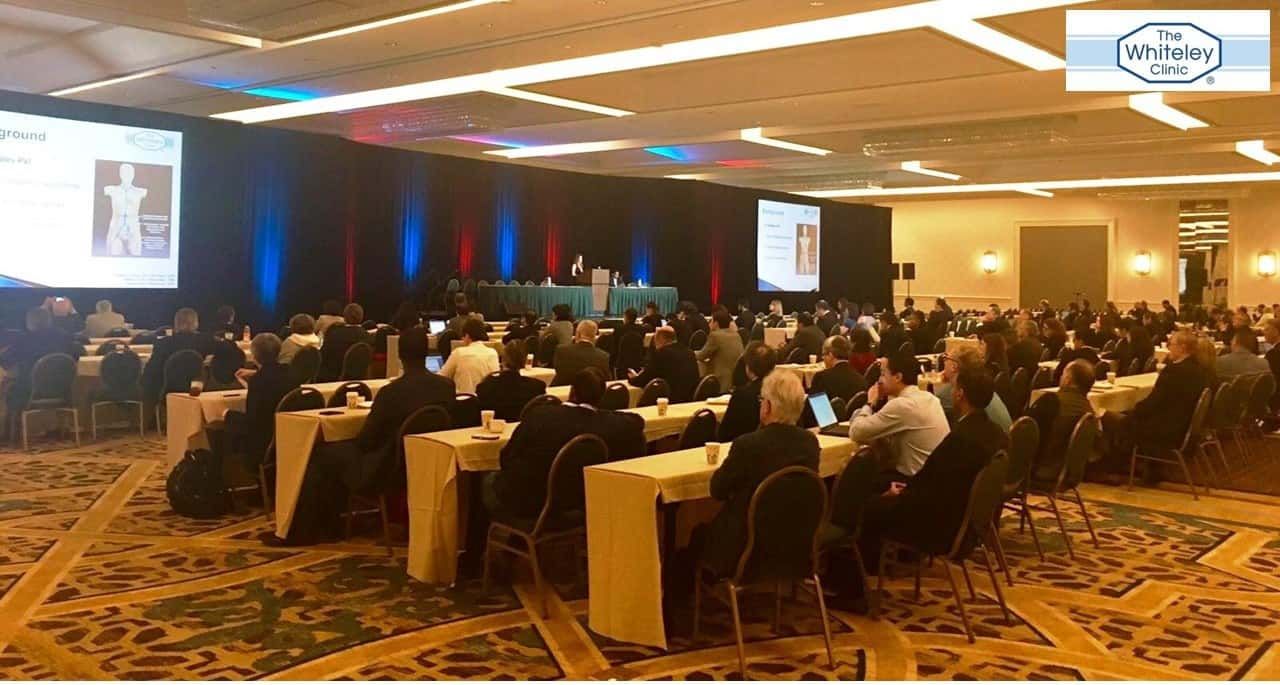
Emma Dabbs presenting - American Venous Forum 17 Feb 2017
Research from The Whiteley Clinic has previously shown that varicose veins in women can arise from pelvic varicose veins. We have previously shown that 1 in 7 women with leg varicose veins actually have them arising from the pelvis. In women who have had children, this rises to 1 in 5. (see: https://www.ncbi.nlm.nih.gov/pubmed/19470861) We have also shown that failure to treat these pelvic varicose veins first is associated with getting recurrent varicose veins back again in the future. (see: https://thewhiteleyclinic.co.uk/research/published-research/varicose-veins-come-back-dont-check-pelvic-veins/) However, the link between pelvic varicose veins and leg varicose veins in men has not been highlighted before. 
Emma Dabbs presenting The Whiteley Clinic research on the link between pelvic and leg varicose veins in men - American Venous Forum 17 Feb 2017
The Whiteley Clinic researcher, Emma Dabbs, has studied the link between pelvic varicose veins and leg varicose veins. She found that approximately 1 in 30 men with leg varicose veins have pelvic varicose veins directly feeding into the leg varicose veins. She also found that a high proportion of these men had previously had varicose veins treated elsewhere and they had come back again. This is highly likely to be due to the fact that no one checked the pelvic veins. Drawing parallels with The Whiteley Clinic research in females, Emma suggested that doctors treating varicose veins in men should always remember that pelvic varicose veins can be a cause of the problem. Not every man will need a pelvic scan but, with careful scanning of the legs, veins arising from the pelvis can be found. These patients can be selected for further investigation to get the best possible results. Not surprisingly, this research has been incorporated into the Whiteley Protocol to ensure that our patients continue to get the best possible treatment and the lowest possible chance of recurrence of varicose veins after treatment.