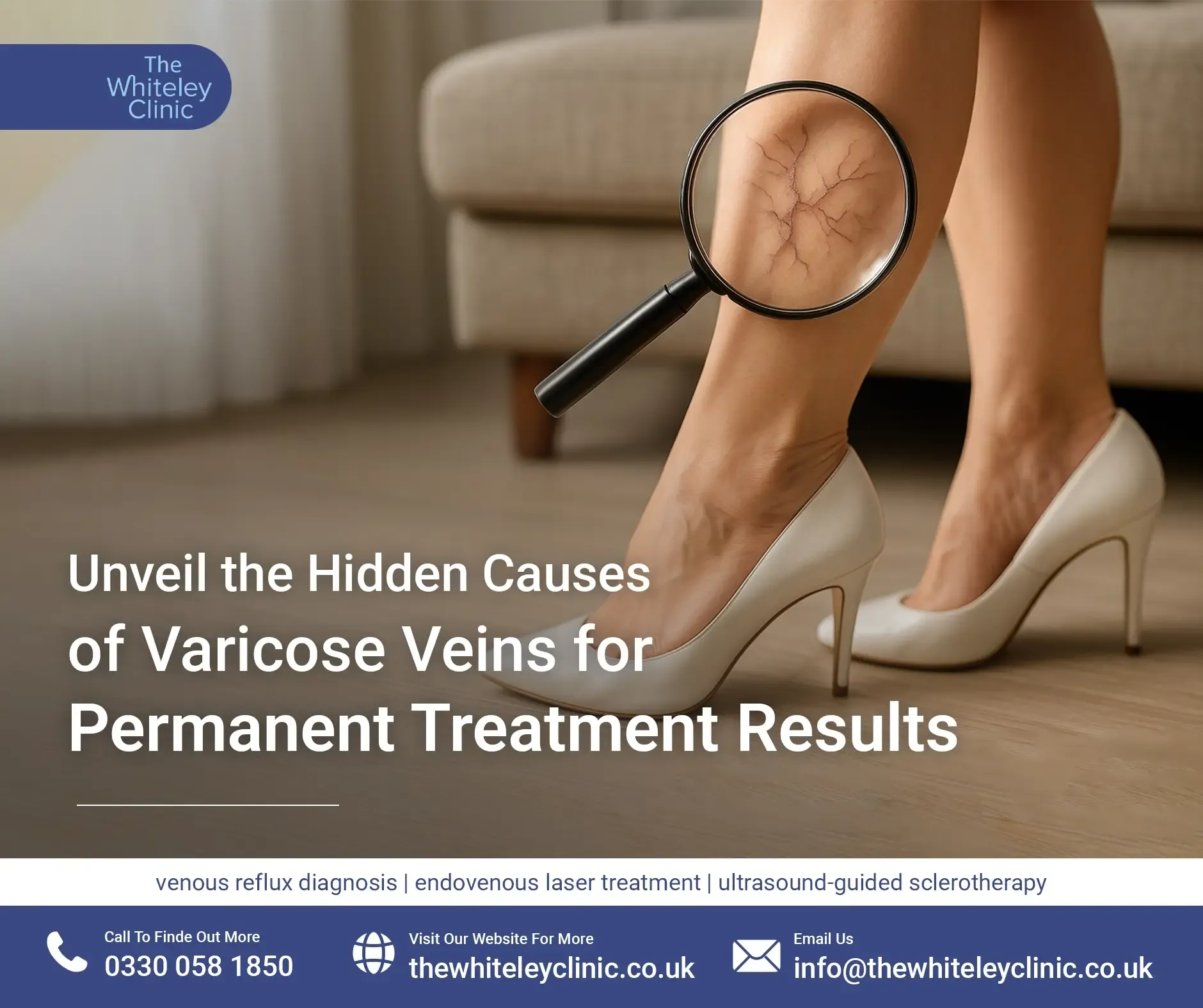
Unveil the Hidden Causes of Varicose Veins for Permanent Treatment Results
February 19, 2026
PUBLISHED BY
Permanent cure for leg ulcers – research from The Whiteley Clinic and published in Phlebology
Phlebology 2013;28:132–139. DOI: 10.1258/phleb.2012.011097
Corresponding author:
MS Whiteley MS FRCS(Gen)
The Whiteley Clinic Stirling House, Stirling Road Guildford, Surrey GU2 7RF, UK Email: [email protected]
Accepted 4 January 2012
This is a retrospective study over 12 years reporting the healing rates of leg ulcers at a specialist vein unit. All patients presented with active chronic venous leg ulcers (clinical, aetiological, anatomical and pathological elements [CEAP]: C6) and had previously been advised elsewhere that their ulcers were amenable to conservative measures only.
Seventy-two patients (84 limbs) were treated between March 1999 and June 2011. Patients were contacted in August 2011 by questionnaire and telephone. Of 72 patients, two were deceased and two had moved location at follow-up, so were not contactable. Fifty patients replied and 18 did not (response rate 74%), representing a mean follow-up time of 3.1 years.
Ulcer healing occurred in 85% (44 of 52 limbs) of which 52% (27) limbs were no longer confined to compression. Clinical improvement was achieved in 98% of limbs.
This study shows that a significant proportion of ulcers currently managed conservatively can be healed by surgical intervention.
Phlebology
2011 National Medical Student Research Conference, London – October 2011
All patients with venous leg ulcers referred to The Whiteley Clinic over 12 years were reviewed. All of them had previously been told by their doctors and nurses looking after their leg ulcers that they were incurable and would need to spend the rest of their lives in compression bandaging.
After investigation and treatment as outlined in The Whiteley Protocol®, 85%of the leg ulcers were cured and did not recur. Even more impressively,52% remained cured and stocking free– returning to a completely normal life.The other 33% of those that were cured continued to wear support stockings in the day time either for leg swelling or for comfort.
Of the remaining 15% of leg ulcers that were not cured by following The Whiteley Protocol®, all bar one had clinical improvements including reduction in pain and size of leg ulcer.
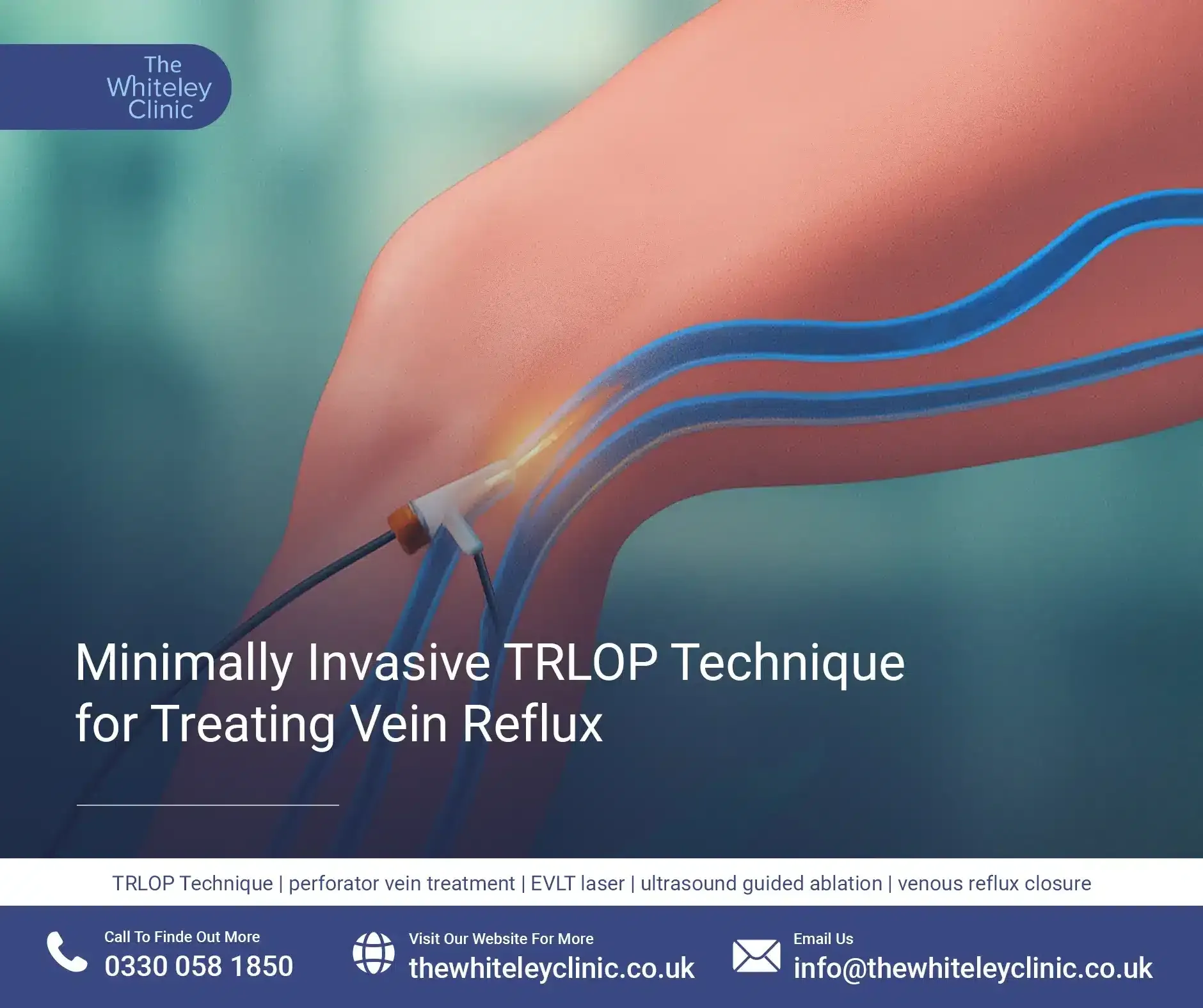
Most patients with a venous leg ulcer are curable by following The Whiteley Protocol® – even when their ulcer team have told them otherwise.This is because traditional assessments of leg ulcers do not include investigation of the underlying cause with high resolution duplex ultrasound, and the latest endovenous treatments, such as TRLOP closure of perforator veins. As most patients with leg ulcers have venous ulcers, then most leg ulcers are now curable by following The Whiteley Protocol®.
Patients with leg ulcers referred to The Whiteley Clinic usually end up with their leg ulcer being permanently cured – and most of these return to a completely normal life and do not even need support stockings.
1. Most leg ulcer care in the UK is directed towards bandaging, nutrition,exercise and a “holistic” approach – but fails to look for a permanent cure. The Whiteley Protocol® turns this on its head– we look for a cure and cure those that are curable – and then give holistic advice to those who aren’t.
2. The cost of curing a leg ulcer is, on average, the same as the cost of 1 year of compression dressing with nursing time. By the second year of a cure, it saves money to have cured the ulcer.
C A Thomas (The Whiteley Clinic Summer Research Fellow 2010 & Medical Student)
J M Holdstock, (Chief Vascular Technologist The Whiteley Clinic)
C C Harrison (Vascular Technologist The Whiteley Clinic)
B A Price (Consultant Venous Surgeon and Consultant Phlebologist The Whiteley Clinic)
Mark S. Whiteley (Consultant Venous Surgeon and Consultant Phlebologist The Whiteley Clinic)
See research online: http://www.ncbi.nlm.nih.gov/pubmed/22833505