Unveil the Hidden Causes of Varicose Veins for Permanent Treatment Results
February 19, 2026
PUBLISHED BY
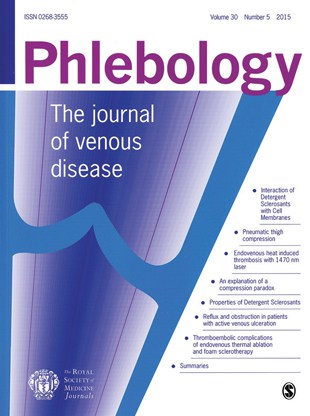
Optimal endovenous radiofrequency treatment of varicose veins Research in the Journal of venous disease
From the The Whiteley Clinica; and the Faculty of Health and Biomedical Sciences, University of Surrey.b
Author conflict of interest: none.
Phlebology 2015 Feb;30(1):17-23. doi: 10.1177/0268355514552005. Epub 2014 Sep 12.
Phlebology 2011; 26: 259 (Abstract of meeting)
To develop a reproducible method of using radiofrequency-induced thermotherapy with adequate thermal spread to ablate the whole vein wall in a truncal vein but avoiding carbonisation, device sticking and high impedance ‘cut outs’ reducing interruptions during endovenous treatments.
Porcine liver was treated with radiofrequency-induced thermotherapy under glass to allow measurements, observation and video recording. Powers of 6–20W were used at varying pullback speeds to achieve linear endovenous energy densities of 18–100 J/cm. Thermal spread, carbonisation of treated tissue and high-impedance cut outs were recorded.
The currently recommended power settings of 18 and 20W produced sub-optimal results. If pulled back at 3 s/cm to achieve linear endovenous energy densities around 60 J/cm, tissue carbonisation and high impedance cut outs occurred.
When high powers and fast pullbacks of 1 s/cm were used, no carbonisation or cut outs occurred but thermal ablation of the liver model was below target due to reduced time for thermal conduction. Low powers (6–12W) with slow pullbacks (6–12 s/cm) achieved target thermal ablation with minimal carbonisation and high impedance cut outs.
Using low power (6W) and a slow discontinuous pullback (6 s every 0.5 cm, in steps), we were able to achieve our target thermal ablation in the porcine liver model without carbonisation and high impedance cut outs.
This suggests the currently recommended power levels could be reduced, reducing the need to remove the device to clean the electrodes during treatment while achieving target thermoablation of the treated tissue.
Although RFiTT is only one of many endovenous thermoablation techniques to treat varicose veins, the lessons learnt from this apply to all endovenous laser treatments and all endovenous radiofrequency ablation treatments.
This study was one of the major turning points marking The Whiteley Protocol® as very different from treatments provided by doctors who merely follow manufacturers guidance and as such, do not get the benefit of in-depth research into these products.
It is because we perform so much research into our treatments that our long-term results and patient satisfaction are so good and stand out from most, if not all, others.
George E Badham (The Whiteley Clinic Summer Research Fellow 2010 & Medical Student)
Sophie M Strong (The Whiteley Clinic Summer Research Fellow 2010 & Medical Student)
11th International Vascular & Endovascular Course (IVEC) and 4th European Congress of the International Society for Vascular Surgery (ISVS) – Milan– October 2010
3rd Prize: An in Vitro Study to Optimise the Treatment of Varicose Veins with RFiTT
GE Badham, SM Strong, MS Whiteley
Phlebology 2015 Feb;30(1):17-23. doi: 10.1177/0268355514552005. Epub 2014 Sep 12.
Phlebology 2011; 26: 259 (Abstract of meeting)
11th International Vascular & Endovascular Course (IVEC) and 4th European Congress of the International Society for Vascular Surgery (ISVS) – Milan, October 2010 (3rd Prize)
Annual Spring Meeting of the Venous Forum of The Royal Society of Medicine, London, April 2011
National Medical Student Research Conference, London – October 2011
This is a photograph of the experiment using a varicose vein RFiTT radiofrequency ablation catheter on some meat from the supermarket. Using the measurements made from this, we were able to prove how to make radiofrequency ablation more successful in treating varicose veins
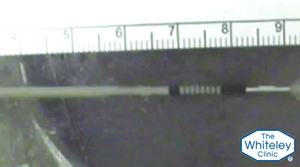
RFiTT is one of the techniques of endovenous thermoablation which is now the NICE approved way of treating varicose veins (NICE CG 168, July 2013).
Up until this study was performed, the company making RFiTT had suggested using a protocol of high-power (18 or 20 W) and pulling the catheter back down the vein at approximately 1 cm every second. If the catheter was pulled back slower, then it would stick and get covered with charcoal. This would stop the device from working.
Using our knowledge of thermoablation to treat varicose veins, we tried to tell the company that this was the wrong technique. As they would not listen to us, we performed this study.
Using meat from the supermarket, we were able to show that by reducing the power and slowing the treatment, we could get the energy to spread more smoothly through the vein wall. We were able to get more energy into the vein wall this way, ensuring the catheter did not stick during treatment and suggesting a better way to treat varicose veins.
The power settings and techniques suggested by the company and used by doctors around the world, is probably suboptimal. This study suggests that anyone using the RFiTT device should use The Whiteley technique as outlined in this paper.
Now that endovenous thermoablation is the 1st choice of varicose vein treatments by the NICE guidelines, it is essential that surgeons treating varicose veins understand the equipment they are using.
The lessons learned from this research shows that a lot of the advice given by manufacturers has not been subjected to in-depth research. To get the best results, it is essential that doctors do their own independent research or, if incapable of doing that, at least use the results from those of us that do.