
Temporal Veins (Temple Veins)
Temple Veins are visible superficial veins that appear on the side of the forehead around the temple. They usually look blue or green and may run vertically from the scalp towards the area beneath the eye. In some people, these veins remain fine and flat. In others, they become larger and bulge beneath the skin. Although Temple Veins are usually a cosmetic concern rather than a medical condition, their appearance can become more noticeable with age, heat or exercise. The appropriate treatment depends mainly on the size, depth and appearance of the vein. Small, non-bulging veins may respond to Nd laser treatment at Absolute Aesthetics, while larger bulging veins may require phlebectomy at The Whiteley Clinic.
What Do Temple Veins Look Like?
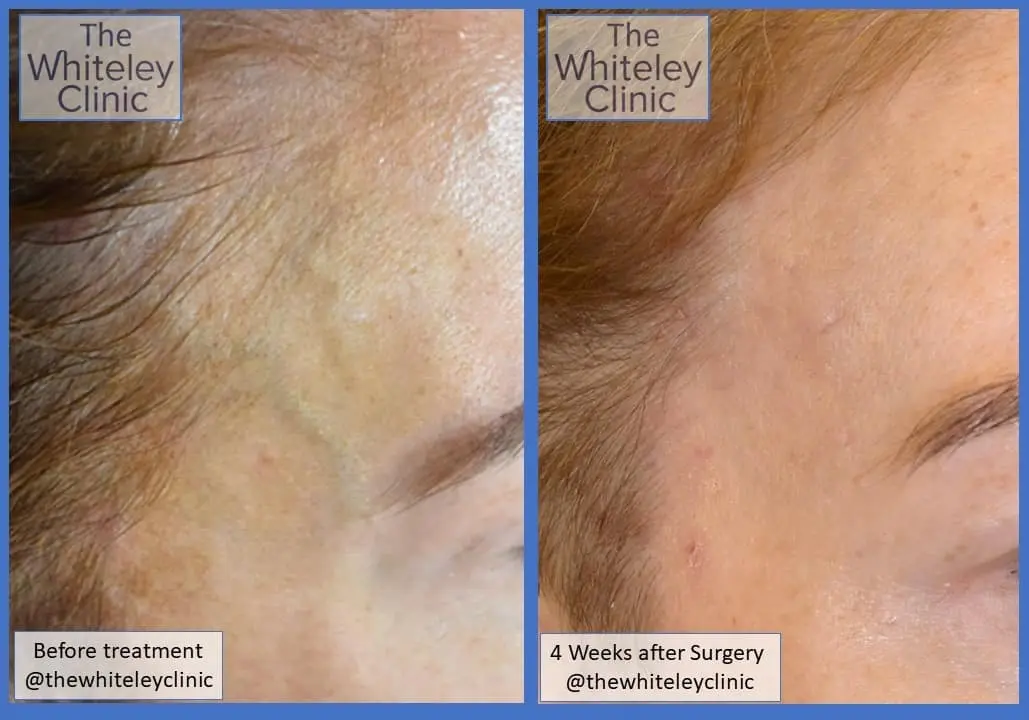
Temple Veins are usually visible as blue or green lines on the side of the forehead. They can extend vertically across the temple and may continue towards the area beneath the eye.
The veins may be:
- Fine and relatively flat
- Blue or green in colour
- More visible in hot weather
- More prominent during exercise or increased blood flow
- Soft rather than firm when touched
- Non-pulsatile
Larger veins can become raised or visibly bulging. This can make them difficult to conceal with make-up and may cause significant cosmetic concern.
A visible vessel in the temple is not always a vein, however. A superficial temporal artery can also become prominent in this area. Unlike a vein, an artery normally has no blue or green colour and may have a palpable pulse. Correctly identifying the vessel is therefore an important first step before treatment.
What Causes Temple Veins to Become More Visible?
Several factors can make Temple Veins easier to see.
Ageing is one of the most common factors. As skin becomes thinner and the soft tissues beneath it change, superficial blood vessels can become more visible. A reduction in subcutaneous tissue can also make an underlying vein appear more prominent.
Genetics can influence the natural size, position and visibility of superficial veins. Some people simply have veins that lie closer to the surface of the skin.
Heat and exercise can temporarily increase blood flow and cause superficial vessels to become more prominent. Alcohol and other causes of vasodilation can have a similar effect.
These factors do not usually mean that the vein is diseased. In most cases, prominent Temple Veins are primarily an aesthetic concern.
How Are Temple Veins Diagnosed?
Diagnosis usually begins with a clinical examination. The appearance, colour, size and position of the vessel are assessed. The specialist may also check whether the vessel collapses with gentle pressure and whether it has a pulse.
This examination helps distinguish a vein from a superficial temporal artery. However, appearance and palpation alone may not always provide a definite diagnosis because arteries and veins can lie close together.
Duplex ultrasound can provide a more detailed assessment when the diagnosis is uncertain or when treatment is being considered. It can identify the type of vessel and show its course, depth and blood flow. This is particularly useful in the temple because the anatomy of the superficial vessels varies between individuals.
If the vessel is blue or green and does not pulsate, it is more likely to be a vein. If it is colourless, firm and pulsatile, a superficial temporal artery is more likely. A doctor should assess any new painful, rapidly enlarging or unusually pulsatile lump rather than treating it as a simple cosmetic vein.
How Do Doctors Treat Small Temple Veins?
Small, superficial and non-bulging Temple Veins may be suitable for Nd laser treatment.
The laser delivers controlled energy through the skin towards the blood vessel. The resulting thermal effect damages the vein, allowing the body to gradually clear the treated vessel. The suitability of laser treatment depends on factors such as vessel size, depth and skin characteristics. Clinical studies support the use of vascular lasers, including 1064 nm Nd lasers, for selected superficial facial vessels.
For fine or non-bulging Temple Veins, the aesthetic practitioners at Absolute Aesthetics assess the veins and provide laser treatment.
What Happens If a Temple Vein Is Large or Bulging?
A large bulging vein may not respond adequately to laser treatment. A larger vessel contains more blood, which can reduce the effectiveness of energy delivered from outside the skin. Doctors cannot simply increase the laser energy because higher energy levels could damage the surrounding skin.
In these cases, phlebectomy may provide a more appropriate treatment.
Phlebectomy removes the affected vein through very small skin openings under local anaesthetic. Specialists remove the vein directly rather than trying to destroy it through the skin. The small openings usually do not require stitches.
At The Whiteley Clinic, specialists assess the vein and determine whether surgical removal is appropriate.
Bruising and local swelling can occur afterwards. The original condition page reports that wounds and bruising usually settle within several days to two weeks, although individual recovery varies.
How Can Doctors Combine Different Treatments?
Yes. Some patients have a combination of larger and smaller Temple Veins.
In these cases, the larger bulging veins can first be removed by phlebectomy at The Whiteley Clinic. Once the area has healed, any remaining small superficial veins may then be treated with Nd laser at Absolute Aesthetics.
This approach allows doctors to choose the most suitable treatment for each vessel based on its size and characteristics, rather than using the same technique for every vein. A previous case at The Whiteley Clinic also demonstrates how phlebectomy can be followed by Nd:YAG laser treatment for smaller veins that remain after the procedure.
Why Do Doctors Avoid Sclerotherapy for Temple Veins?
Sclerotherapy involves injecting a chemical sclerosant into a vein to cause it to close. Although sclerotherapy is widely used for veins elsewhere in the body, treatment of facial and temple veins requires particular caution.
The venous anatomy around the forehead, temple and orbit includes connections with deeper vessels. Rare but severe ocular complications have been reported after facial sclerotherapy, including ophthalmic artery occlusion and permanent visual loss.
For this reason, specialists at The Whiteley Clinic do not routinely use sclerotherapy to treat Temple Veins. Instead, specialists select the most appropriate treatment after assessing the individual vascular anatomy.
Should Temple Veins Be Treated at The Whiteley Clinic or Absolute Aesthetics?
The right treatment depends on the size and appearance of the vein. Fine, non-bulging Temple Veins may be suitable for Nd laser treatment at Absolute Aesthetics. Larger, bulging veins may be unsuitable for laser treatment and can be removed by phlebectomy at The Whiteley Clinic. If smaller veins remain after healing, further Nd laser treatment may be considered at Absolute Aesthetics.
A visible vessel in the temple may not always be a vein. The superficial temporal artery is a different type of blood vessel. Unlike a vein, it is colourless and has a palpable pulse. Anyone who is unsure whether a prominent temple vessel is a vein or an artery should have it assessed before treatment. For reassurance, a consultation with a specialist at The Whiteley Clinic can help identify the vessel and determine the most suitable treatment. Where appropriate, specialists can then refer patients to Absolute Aesthetics for laser treatment.