
How Can You Effectively Treat Calluses and Corns on Feet?
August 15, 2026
Varicose veins occur because the valves in the leg veins stop working or fail. The result of this is that when patients with varicose veins stand up, blood in their leg veins falls down to the ankle, causing an impact pressure on the veins lower down in the legs. The column of blood from the heart to these veins is heavy, stretching the vein wall and hence causing varicose veins. We have already discussed this in CEAP C2 disease.
CEAP is a classification used to describe chronic venous disease. C3 refers to oedema, or swelling, in the affected leg. Visible varicose veins do not have to be present for a leg to be classified as C3. Of course we know that for everybody who has visible varicose veins, there is another person who has “hidden varicose veins”. In these patients with “hidden varicose veins”, the same valves have failed causing venous reflux, but the veins near the surface have not dilated. The result of this is the same internal problem with blood falling the wrong way down the veins, but no visible varicose veins.
However, ankle swelling alone does not establish a venous cause. Clinical assessment and, where appropriate, duplex ultrasound help identify the underlying problem. CEAP describes the clinical findings; it does not mean that every patient will progress through each class in sequence.
As CEAP C3 is physical damage due to inflammation from the varicose veins and venous reflux, this is clearly worse than the C2 disease where there is no damage to the tissues surrounding the varicose veins. Therefore it is not surprising that in the UK the NICE (National Institute of Health and Clinical Excellence) and elsewhere in the world other regulatory bodies, suggest that C3 is a medical condition that should be funded for treatment.
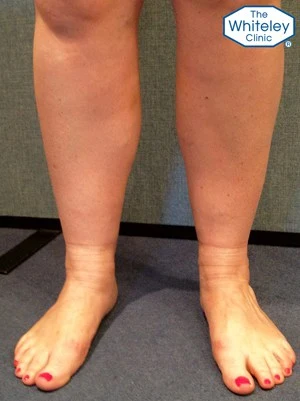
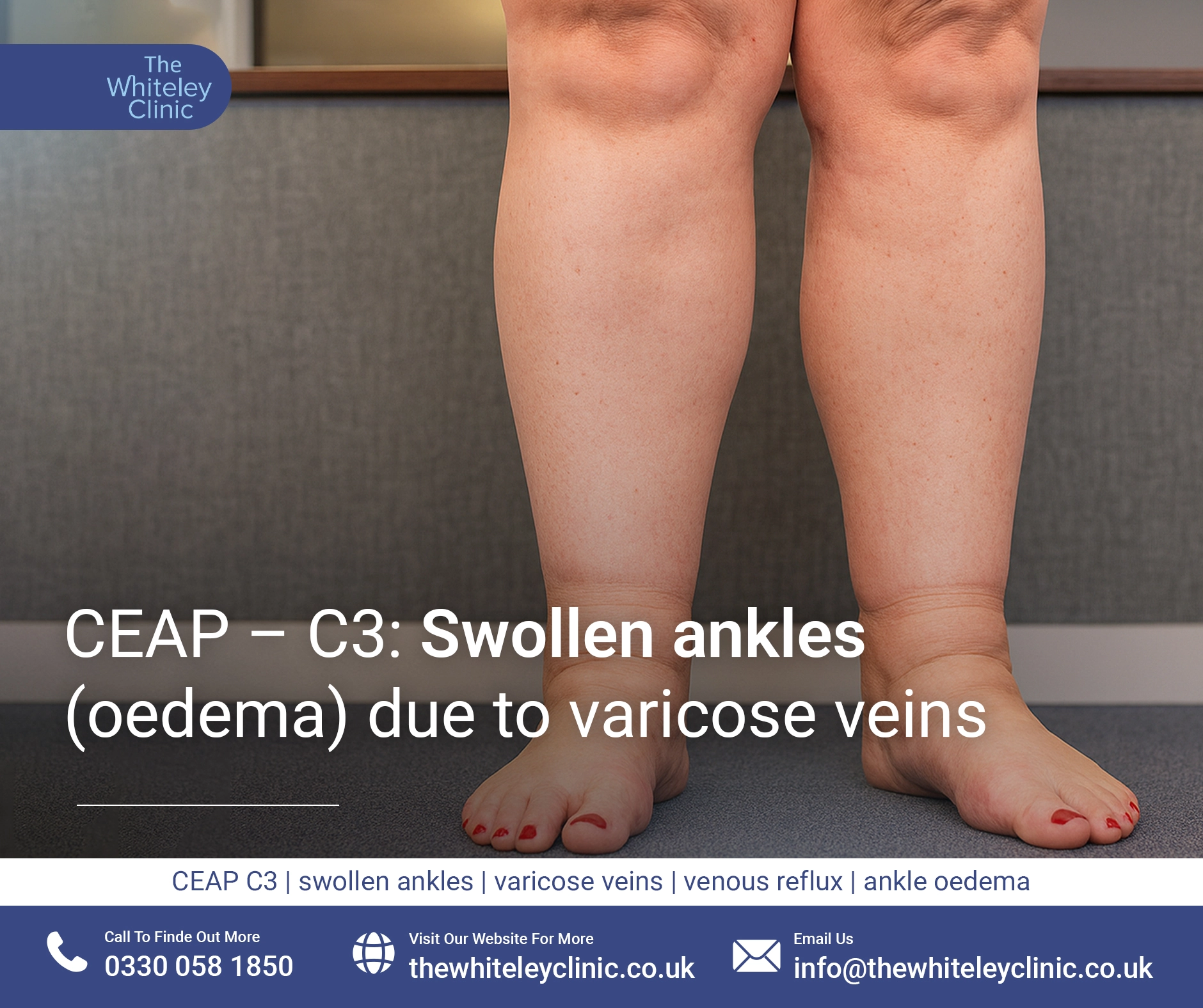
Swollen ankle with varicose veins and stock imprints – CEAP C3
So what is actually seen when you examine yourself or someone whom you suspect to have CEAP C3 disease?
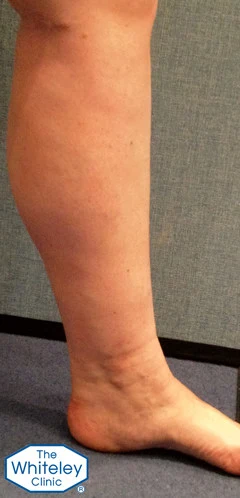
there should be swelling of the ankles. Although this would appear to be obvious, there are certain points to this swelling that are well worth knowing.
The distribution of swelling can help guide assessment, but it cannot establish the cause on its own. Swelling involving the top of the foot and the toes may suggest lymphoedema.
Venous and lymphatic problems can also occur together. Longstanding venous disease may impair lymphatic drainage, producing a combination known as phlebolymphoedema. Swelling that extends beyond the ankle therefore needs assessment rather than being attributed to, or ruled out as, a venous problem based on appearance alone.
In most cases, the swelling is probably less than you would imagine. In the mornings, when you first wake up, the swelling from CEAP C3 venous oedema is rarely noticeable. This is because when you have been lying down for several hours, there has been no venous reflux as the valves have not been needed to act as antigravity devices. Hence blood flow from the legs has been normal and there has been no build up of fluid at the ankles.
After getting up and starting the day, venous oedema will start to form as the day progresses. The speed at which it forms depends on several things including the severity of the varicose veins or hidden varicose veins (venous reflux), how active you are and what you are doing (i.e. standing, sitting, swimming et cetera). Generally, as the day progresses some swelling occurs at the ankles. This is usually only noticed by the imprint of socks at the ankle when they are removed. If the swelling is huge and makes the socks tends cause the foot to swell inside a shoe, once again one should suspect other causes of swelling including lymphoedema. The swelling of CEAP C3 venous oedema is usually more subtle than you might expect.
There are a couple of possible causes for the swelling found in CEAP C3 disease from varicose veins. These causes may well be linked. As noted above, varicose veins or “hidden varicose veins” (venous reflux) occurs because the valves in one or more of the leg veins fail. On standing, blood tries to fall with gravity back towards the ankles down the veins. In normal people, the valves close, stopping the backward flow or “reflux” of the venous blood.
If the valves in any of the veins have failed or have stopped working, blood falls back down the veins by gravity. This ends up with a column of blood that may stretch from heart all the way down to the ankle. The pressure on the vein wall at the bottom of this column of blood can be very high, forcing fluid from the blood out through the vein wall and into the surrounding tissue.
Research has also shown that there is inflammation in the blood within the veins when there is venous reflux. Therefore another possible cause is that when the blood falls down the veins, it hits the vein at the ankle, causing inflammation. One of the consequences of inflammation is swelling. You will know this from any time you have bumped yourself – the area goes hot, red, swollen and is painful. Not surprisingly, in CEAP C3 disease, the ankle is swollen and is often a little redder, warmer and can quite often ache. This suggests that inflammation may be involved rather than just pressure of the column of blood.
Our research has also suggested other reasons why inflammation might be involved but that is probably beyond the scope of this webpage.
If you are interested in this subject and want to read more, please see the book Understanding Venous Reflux – the cause of varicose veins and venous leg ulcers.
Varicose veins are one possible cause of ankle swelling. Other causes include certain medicines, lymphatic problems and conditions affecting the heart, kidneys or liver. A blood clot or infection may also cause swelling.
More than one cause can be present. Assessment should consider when the swelling began, whether one or both legs are affected, other symptoms and current medicines. Finding venous reflux on a scan does not necessarily explain all of the swelling.
If you suspect that you have CEAP C3 swollen ankles due to varicose veins, it is essential that you have a venous duplex ultrasound scan performed by a specialist vascular Scientist to identify whether the swelling is due to venous reflux. Although many doctors performing their own scans may be able to see reflux in the big veins such as the great saphenous vein and the small saphenous vein, only specialist centres with specialist vascular scientists specialise in venous duplex ultrasound scans will be able to regularly and accurately diagnose the less well-known causes of venous reflux, such as perforator vein incompetence, pelvic vein incompetence and isolated deep vein incompetence.
In addition, it is essential that the deep veins are examined in detail as swelling can also be due to obstruction or partial obstruction of the deep veins rather than just reflux. To get the correct treatment it is important to know the difference between these two conditions particularly as they can coexist.
Graduated compression stockings can help reduce venous swelling and ease symptoms, although they do not repair faulty vein valves. Their role depends on the patient’s symptoms, circulation and suitability for other treatment.
For patients with varicose veins who are suitable for an intervention, NICE recommends treatment of the affected veins rather than compression hosiery alone. Compression may still be used when an intervention is unsuitable and may form part of care while awaiting treatment or during recovery.
The type and strength of compression should be selected following clinical assessment, as compression is not suitable for everyone.
Once the venous duplex ultrasound scan has been performed, any fluid around the ankles (venous oedema) will have been seen on the duplex ultrasound scan as fluid shows up very clearly. In addition, any venous reflux will also have been identified if the scan has been performed by a specialist vascular scientist. The level and amount of reflux and the amount of oedema can then be assessed by a specialist in vein surgery to check that they correlate. If they do, a diagnosis of CEAP C3 venous oedema due to varicose veins can be confirmed.
Although it is not essential to operate if the patient does not want to, failure to treat this condition will almost always lead to further deterioration and worsening of the signs and symptoms. Unless the patient is particularly unwell or there are other extenuating circumstances, almost every venous expert in the world would suggest that the venous reflux is stopped by treating the varicose veins or “hidden varicose veins”. The treatment used will depend upon the pattern of reflux and may include:
Treating venous reflux may reduce ankle swelling when the reflux contributes to the problem. However, swelling can have more than one cause, so successful vein treatment does not always lead to complete resolution.
Longstanding swelling may also involve impaired lymphatic drainage. Some patients therefore need ongoing measures to control oedema after treatment. The assessment should include a discussion of the improvement that can reasonably be expected and whether further care may be needed.